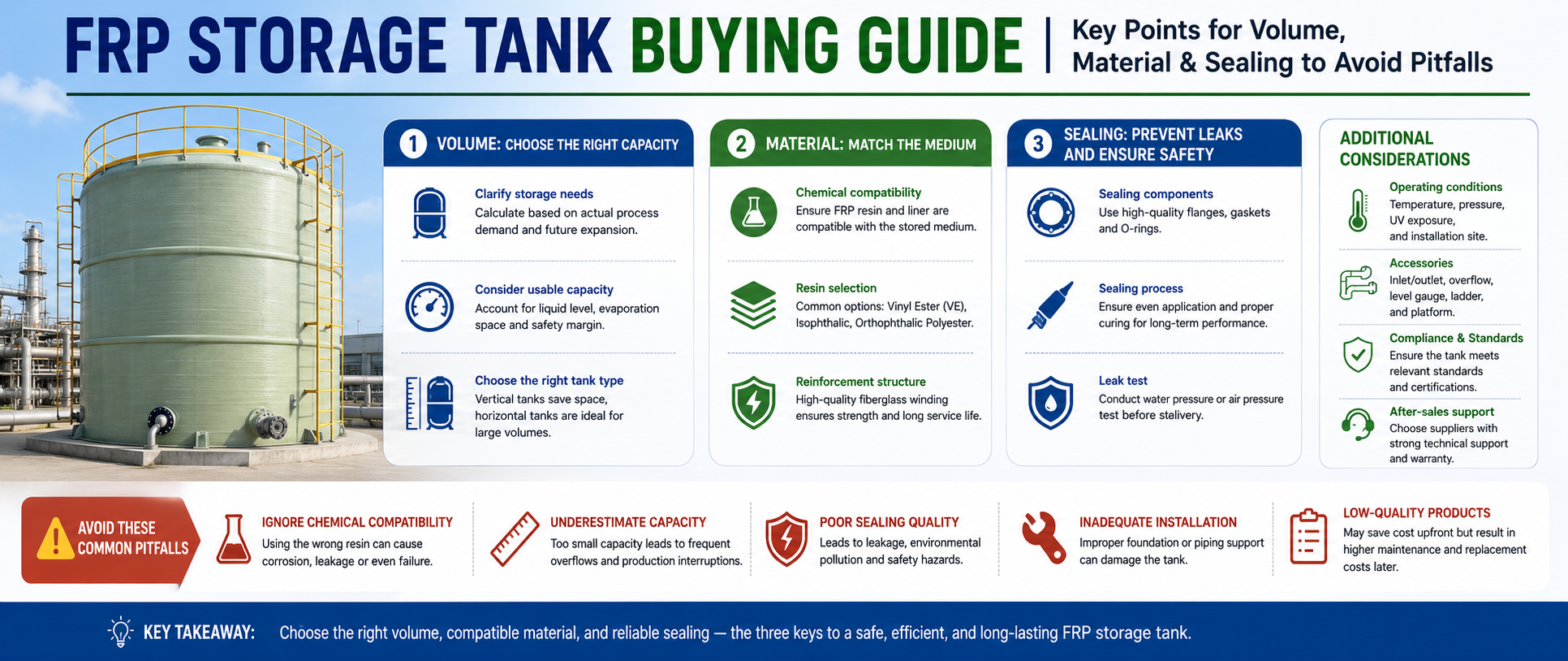
FRP (Fiberglass Reinforced Plastic) storage tanks are widely applied in chemical, environmental protection, municipal engineering, food and beverage industries for storing acid‑base liquids, sewage, drinking water, chemical raw materials and industrial wastewater, thanks to their outstanding advantages of corrosion resistance, long service life, lightweight structure and low maintenance cost. However, the quality of FRP tanks varies greatly in the market. Many buyers encounter troubles like virt
## 1. Volume Customization: Avoid Virtual Marking, Select Tank Capacity Precisely
FRP storage tanks are available in vertical, horizontal and underground types, with customizable volumes ranging from 1m³ to 1000m³. False volume labeling and insufficient effective capacity are the most common traps in purchasing.
1. Distinguish Total Volume from Effective Volume
The nominal volume marked on tanks is not the actual usable capacity. Vertical FRP tanks require 10% headspace for safety, while horizontal tanks need 8% reserved space. Always confirm the effective volume with manufacturers to prevent liquid overflow.
2. Select Volume Based on Stored Medium & Application Scenarios
- Chemical waste liquid storage: Calculate volume by daily discharge × 7‑15 days reserve capacity
- Drinking water & domestic water storage: Size tanks according to daily water consumption and user population
- Underground sewage tanks: Customize capacity combined with sewage flow of septic tanks and wastewater treatment stations
3. Key Pitfall Reminder
Avoid manufacturers that only quote nominal volume without clarifying effective capacity. Request official drawings and capacity calculation reports before ordering.
## 2. Material Selection: Match Resin & Fiberglass with Stored Medium
The corrosion resistance and service life of FRP tanks mainly depend on resin type and fiberglass material. Wrong material selection will cause tank wall corrosion, penetration and damage in short‑term use.
### 2.1 Core Resin Types for Different Media
- Orthophthalic Polyester Resin: For clean water, domestic sewage, neutral liquid, suitable for municipal water tanks and general wastewater storage tanks
- Isophthalic Polyester Resin: For low‑concentration acid, alkali, salt water, widely used in industrial wastewater and light‑corrosive chemical liquid storage
- Vinyl Ester Resin: For high‑concentration strong acid, strong alkali, organic solvent, ideal for chemical industrial FRP storage tanks with high‑corrosion medium
- Food‑grade Resin: For drinking water, beverage, edible liquid storage, compliant with food hygiene standards
### 2.2 Fiberglass Material Standard
Choose alkali‑free glass fiber with high tensile strength and corrosion resistance. Low‑quality medium‑alkali or high‑alkali glass fiber will reduce tank durability and shorten service life.
### 2.3 Pitfall Reminder
Never use general‑purpose resin tanks for strong‑corrosive chemical storage. Confirm resin grade and medium resistance report from suppliers.
## 3. Sealing Performance: Critical Standard to Prevent Liquid Leakage
Sealing failure is the top cause of FRP tank leakage. Sealing quality mainly relies on tank body structure, flange connection and gasket material.
1. Sealing Inspection Methods
- Visual check: No cracks, bubbles, delamination on tank inner and outer walls
- Pressure test: Conduct hydrostatic pressure test (1.5 times working pressure) for 24 hours, no leakage allowed
- Air tightness test: For volatile chemical medium storage tanks, perform air tightness test to avoid gas leakage
2. Key Sealing Components
Use acid‑alkali resistant EPDM or PTFE gaskets for flange connections. Ordinary rubber gaskets will age and crack under corrosive environments.
3. Pitfall Reminder
Reject tanks with thin wall thickness, uneven winding layers and rough flange interfaces, which lead to poor sealing performance.
4. Standard Installation & Daily Maintenance to Extend Tank Service Life
Even high‑quality FRP tanks will fail with improper installation and maintenance. Follow below standards for long‑term stable operation.
4.1 Installation Guidelines
Vertical tanks: Install on flat concrete foundation, ensure verticality to avoid tank tilting
Horizontal & underground tanks: Do anti‑corrosion treatment on foundation, backfill graded sand evenly around tanks
Pipeline connection: Avoid rigid connection stress on tank flanges, use flexible joints
4.2 Daily Maintenance Tips
Regularly check flange gaskets for aging and leakage
Clean tank interior periodically to remove sediment and scaling
Avoid impact and heavy pressure on tank outer wall
For underground tanks, inspect anti‑corrosion layer regularly
5. Common FRP Tank Problems & Practical Solutions
Liquid Leakage
Causes: Poor sealing, wall crack, flange damage
Solution: Replace sealing gaskets; repair cracks with FRP lining; reinforce damaged flanges
Tank Wall Delamination & Bubble
Causes: Unqualified resin‑glass fiber combination, poor production process
Solution: Avoid low‑quality hand‑layup tanks; choose filament‑wound FRP tanks with stable quality
Premature Corrosion
Causes: Mismatched resin material for stored medium
Solution: Re‑select medium‑resistant resin grade, conduct anti‑corrosion lining repair
Tank Deformation
Causes: Insufficient wall thickness, overloaded storage
Solution: Select tanks with thicker winding layers; strictly follow rated volume for medium storage
Conclusion
Buying high‑quality FRP storage tanks requires full consideration of effective volume, medium‑matched material, sealing performance, installation standard and maintenance plan. As a professional FRP manufacturer, we provide customized fiberglass storage tanks with different volumes, resin grades and structures for water treatment, chemical industry, municipal engineering and environmental protection projects.
We support OEM & bulk supply, offer free technical consultation, medium‑resistant solution design and on‑site installation guidance. Contact us to get your customized FRP tank solution.