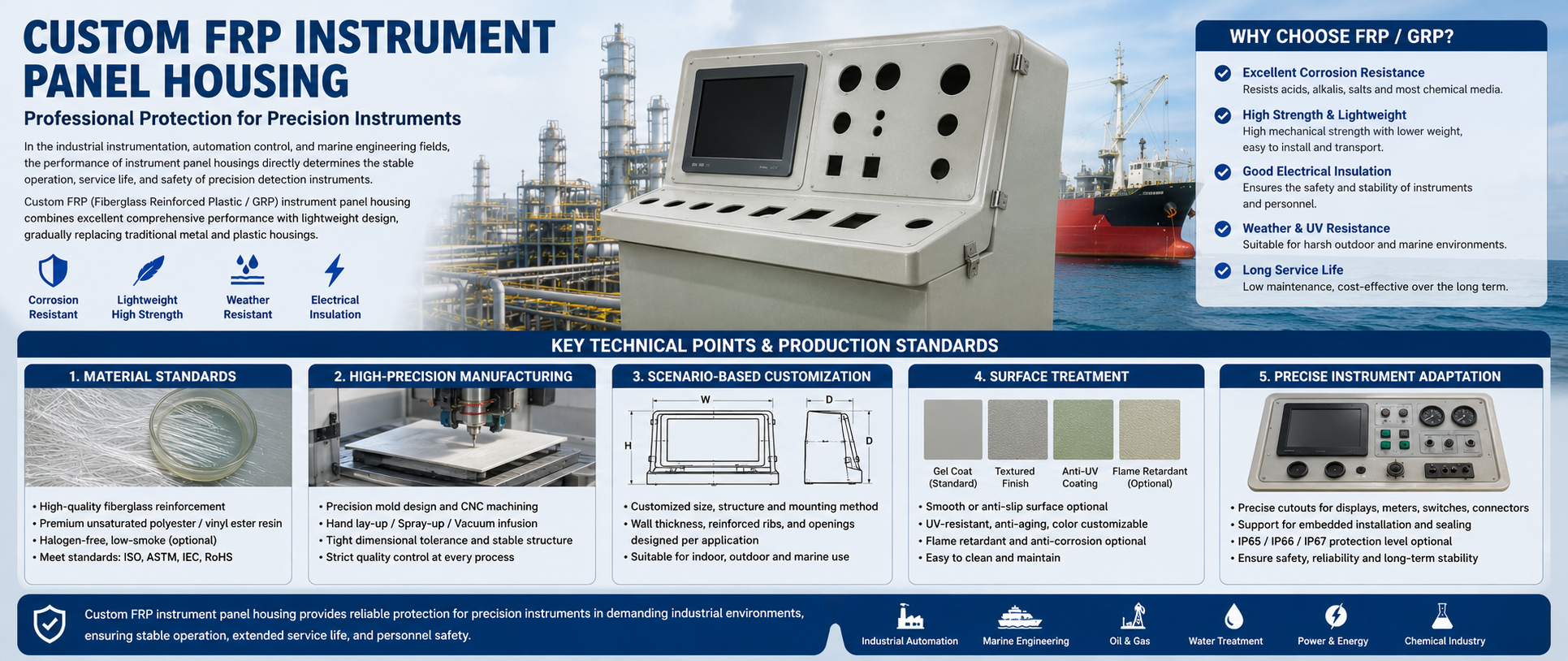
Key Insights on Material Selection, Precision Control and Perfect Adaptability
In the industrial instrumentation, automation control, and marine engineering fields, the performance of instrument panel housings directly determines the stable operation, service life, and safety of precision detection instruments. As a high-performance lightweight protective component,custom fiberglass reinforced plastic (FRP/GRP) instrument panel housing has gradually replaced traditional metal and plastic housings due to its excellent comprehensive performance. To meet the diverse and rigorous application requirements of industrial scenarios, customized production focusing on professional material standards, high-precision manufacturing, scenario-based size customization, fine surface treatment and accurate instrument adaptation has become the core demand of the industry. This article will comprehensively analyze the key technical points and production standards of FRP instrument dashboard housing customization for industrial users.
1. Professional Material Selection Standards for Custom FRP Instrument Panel Housings
The material performance of FRP instrument housing is the foundation of its long-term stable operation in complex industrial environments. Different from ordinary civil FRP products, industrial-grade customized instrument panel shells have strict mandatory requirements on insulation performance, corrosion resistance, weather resistance and structural toughness, which are core indicators that cannot be ignored in customization.
Excellent Electrical Insulation Performance: Industrial instruments involve precise circuit systems and signal detection components, so the customized FRP housing must have superior non-conductive properties. We adopt high-purity resin matrix and alkali-free glass fiber reinforcement materials, which can effectively isolate current, prevent static accumulation and electric leakage risks, and fully protect the internal precision circuit of the instrument. This insulation design is especially suitable for high-voltage workshops, chemical production workshops and petrochemical industrial scenarios with strict electrical safety requirements.
Superior Chemical Corrosion Resistance: In chemical, marine, coastal and humid industrial environments, instrument housings are easily eroded by acid, alkali, salt mist, chemical vapor and humid air. Custom industrial-grade FRP materials have stable chemical properties, which can resist long-term corrosion of various inorganic and organic chemical media, avoid shell aging, cracking, rust and deformation problems caused by environmental erosion, and greatly extend the service cycle of instrument panel equipment.
In addition to the two core performances of insulation and corrosion resistance, customized FRP housing materials also have good flame retardancy, impact resistance and low-temperature resistance. They will not be brittle or deformed in extreme temperature environments, ensuring the structural integrity and protective performance of the instrument housing in all-weather industrial operation.
2. High-Precision Manufacturing Control Methods for FRP Dashboard Housing Customization
Precision is the core competitiveness of customized FRP instrument panel shells. The assembly gap, hole position accuracy and overall flatness of the housing directly affect the installation efficiency and operating stability of the instrument. In order to solve the problems of large dimensional error, uneven hole position and poor fitting degree of ordinary FRP products, we adopt a full-process precision control system in customized production.
Precision Mold Opening & Digital Modeling: According to the customer’s instrument parameter drawings and on-site installation environment, we use 3D digital modeling technology to carry out overall structural optimization design, and manufacture high-precision integral molds. The mold precision is controlled within ±0.02mm, which fundamentally avoids dimensional deviation caused by manual production errors and ensures the consistency of batch customized products.
Strict Dimensional Tolerance Control: For key installation parts such as instrument display windows, fixing bolt holes, wiring ports and assembly flanges, we implement ultra-strict tolerance standards. The overall dimensional tolerance of the housing is controlled within ±0.1mm, and the hole position symmetry and flatness of the mounting surface are calibrated by professional precision testing equipment to ensure zero obstacle in subsequent instrument assembly.
Post-Processing Precision Calibration: After the molding of FRP housing, we carry out secondary precision trimming, deburring and flatness correction. All edges and corners are polished smoothly, and the assembly contact surface is finely calibrated to eliminate tiny errors generated in the molding process, ensuring that the precision of each customized housing meets industrial instrument assembly standards.
3. Standardized Size Customization Process for FRP Instrument Panel Housings
Each industrial instrument has different structural specifications, installation methods and on-site layout requirements, so one-size-fits-all standard products cannot meet actual engineering needs. We have formed a mature and standardized full-process customization process to realize personalized size and structural customization while ensuring product precision and performance.
Demand Communication & Parameter Confirmation: In the initial stage of customization, professional technical engineers communicate with customers in depth to confirm core parameters including instrument overall size, display area size, number and position of wiring holes, fixing mode, installation depth and on-site environmental conditions, and sort out detailed customization technical documents.
3D Drawing Design & Scheme Review: According to the confirmed parameters, the design team completes 3D structure drawing design and structural stress analysis, optimizes the shell thickness, reinforcement structure and hole position layout, and feeds back the design scheme to customers for confirmation and modification to avoid structural defects affecting subsequent use.
Mold Manufacturing & Trial Production Sampling: After the design scheme is finalized, high-precision production molds are manufactured, and trial production samples are made. The samples are comprehensively tested for size, precision, structural stability and performance, and mass production is carried out only after passing the customer’s confirmation and factory inspection.
Mass Production & Finished Product Inspection: In the mass production stage, we strictly follow the process standards and precision control specifications. After the finished product is completed, each housing is inspected in terms of size precision, surface quality, insulation performance and corrosion resistance to ensure that all products meet the customized technical requirements.
4. Practical Surface Treatment Skills for Custom FRP Instrument Housings
The surface treatment of FRP instrument panel housing not only affects the overall appearance of the equipment, but also directly improves the environmental adaptability and wear resistance of the shell. Combined with industrial application scenarios, we adopt targeted surface treatment processes to balance beauty, durability and practicality.
Smooth Anti-Aging Coating Treatment: The surface of the customized housing is polished in multiple processes to remove burrs, pits and uneven textures, and then coated with special industrial anti-aging resin coating. This process can effectively resist ultraviolet radiation, prevent shell fading, powdering and aging, and keep the surface smooth and flat for a long time in outdoor and open-air industrial environments.
Anti-Static & Wear-Resistant Surface Process: For electronic instrument scenarios with high requirements for static prevention, we add anti-static coating treatment on the surface of the housing to avoid static adsorption of dust, ensure the clarity of the instrument display window and the sensitivity of operation keys. At the same time, the surface wear-resistant treatment can resist daily friction and scratch damage during equipment operation and maintenance.
Custom Color & Marking Treatment: According to customer’s equipment style and on-site management standards, we support customized spraying of various industrial standard colors, and can carry out precision screen printing, laser marking of instrument parameters, model numbers and safety signs, making the instrument panel housing more standardized and easy to identify and manage.
5. Key Adaptability Notes for FRP Housing and Instrument Matching
High-precision size and excellent material performance are the foundation, and accurate adaptive matching with the instrument body is the key to ensure the normal operation of the equipment. In the customization process, we need to focus on multiple adaptation details to avoid assembly failure and performance attenuation caused by mismatching.
Internal Structural Adaptation of Instrument Components: The internal space layout of the housing needs to accurately match the internal circuit board, sensor, display module and wiring harness structure of the instrument. We reserve reasonable heat dissipation gaps and wiring spaces according to the instrument internal structure, avoiding extrusion and friction between the housing and internal precision components, and ensuring the normal heat dissipation and signal transmission of the instrument.
Installation & Fixation Adaptability: Different instruments adopt different installation methods such as embedded, wall-mounted and desktop installation. In the customization, we design matching fixing flanges, mounting holes and connecting structures according to the actual installation mode, ensuring firm installation, no shaking, no gaps, and improving the overall stability of the equipment.
Environmental Adaptation Matching: Combined with the actual operating environment of the instrument, we adjust the material formula and structural design in a targeted manner. For high-humidity and corrosive environments, we strengthen the corrosion-resistant and sealed structure of the housing; for high-temperature and strong-light environments, we optimize the anti-aging and heat-insulating performance of the shell, realizing the perfect adaptation of customized housing and scenario environment.
Sealing & Protection Adaptability: For instruments that need dust-proof and waterproof protection, we carry out targeted sealing structure design for the housing assembly gap and wiring holes, supporting IP65/IP67 high-level protection customization, which can effectively block external dust, water vapor and impurities from entering, and protect the internal precision instruments from environmental interference.
Conclusion
The customization of high-precision corrosion-resistant insulated FRP instrument panel housing is a systematic project integrating material optimization, precision manufacturing, standardized process and adaptive matching. Only by strictly controlling material insulation and corrosion resistance, implementing full-process precision dimension control, standardizing customized production processes, optimizing surface treatment effects, and focusing on all-round adaptive matching with instruments and application scenarios, can we produce high-quality FRP instrument housings that meet the rigorous requirements of industrial production. For industrial enterprises pursuing long-term stable equipment operation, professional customized FRP instrument panel housing is a reliable protective solution with high cost performance and strong environmental adaptability.