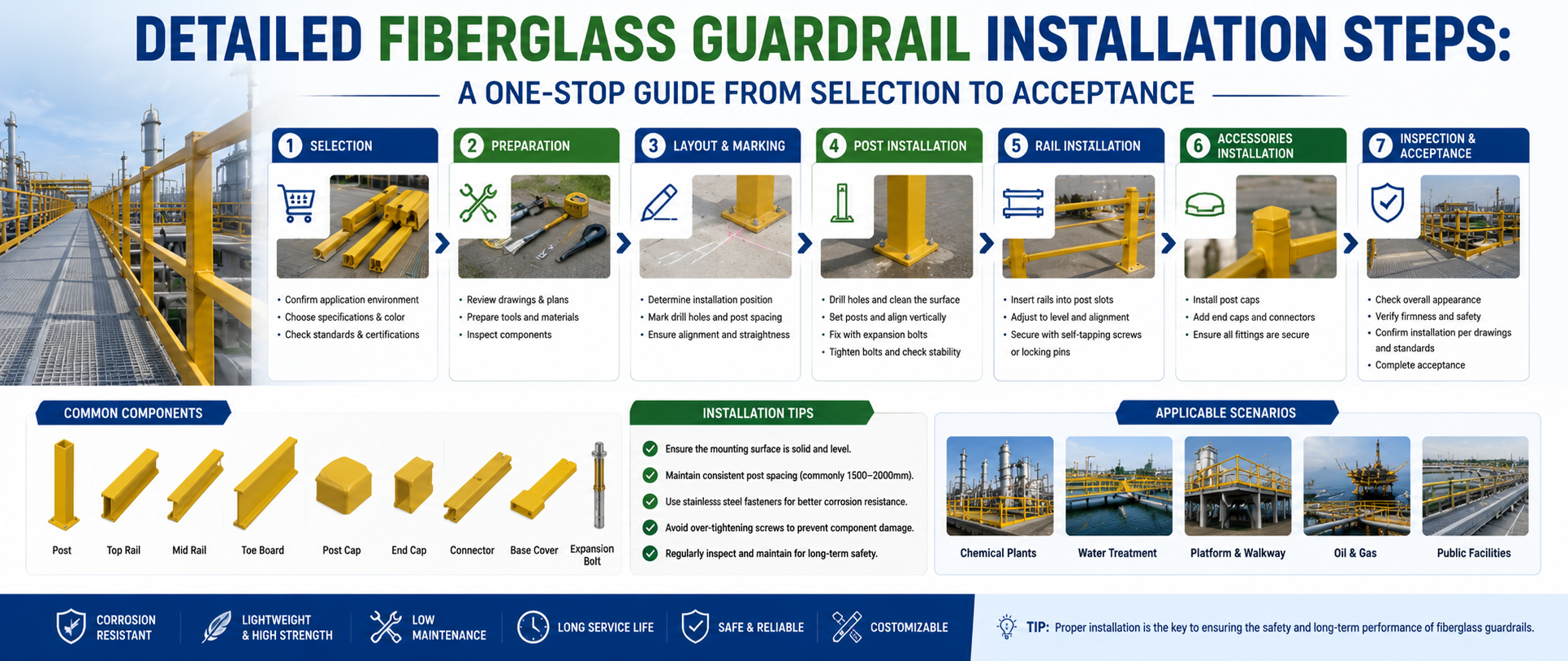
FRP fiberglass guardrails are ideal safety barriers for industrial, commercial and residential use. Corrosion-proof, lightweight and rust-free, they outperform metal, wood and concrete railings in coastal, chemical and sewage sites. This complete guide delivers error-free fiberglass guardrail installation, including selection, tools, assembly, fixing, inspection, maintenance and color customization.
1. Professional Fiberglass Guardrail Selection: Height & Thickness Standard
Reasonable fiberglass guardrail selection is the premise of stable installation and long-term service life. Most installation failures and safety hazards stem from inappropriate model selection. The core selection indicators focus on guardrail height and wall thickness, matched with actual usage scenarios.
1.1 Guardrail Height Selection
The height of FRP guardrails is strictly divided by application scenarios to meet safety protection specifications. For residential courtyard, villa terrace, and community walkway applications, the conventional height is 1.0m–1.2m, which balances safety and aesthetics. For industrial workshops, equipment isolation, and factory passageways, the recommended height is 1.2m–1.5m to prevent personnel and equipment from accidentally falling or colliding. For special scenarios such as chemical tank areas, high-altitude platforms, and sewage pool edges, the height should reach 1.5m–1.8m, complying with national industrial safety standards. For children’s playgrounds and scenic pedestrian paths, the height must not be lower than 1.1m to eliminate safety risks for minors.
1.2 Guardrail Thickness Selection
Wall thickness determines the impact resistance and structural stability of fiberglass safety guardrails. The conventional pipe wall thickness ranges from 2.0mm to 5.0mm. Thin-walled fiberglass guardrails (2.0mm–2.5mm) are suitable for light-load scenarios such as residential decoration, landscape isolation, and indoor zoning, featuring low cost and light weight. Medium-thickness guardrails (3.0mm–4.0mm) are the most versatile option, ideal for outdoor communities, park roads, and general industrial isolation, with balanced toughness and compression resistance. Thick-walled fiberglass guardrails (4.0mm–5.0mm) are customized for heavy-duty industrial scenarios, including factory equipment protection, chemical plant anti-corrosion isolation, and high-wind coastal areas, capable of resisting strong impact and external pressure.
2. Essential Tools for Fiberglass Guardrail Installation
Before starting fiberglass guardrail installation, prepare all matching tools to ensure smooth construction and accurate installation. Professional and complete tools can effectively improve installation efficiency and reduce installation gaps and deviations. The essential tools are listed as follows:
Measuring tools: Tape measure, level, laser calibrator (to ensure horizontal and vertical installation of guardrails);
Cutting tools: Electric cutting machine, fine-tooth saw (special for cutting fiberglass pipes to avoid pipe wall cracking);
Fixing tools: Electric drill, expansion bolts, stainless steel screws, fixed connectors, embedded parts;
Auxiliary tools: Sandpaper, cleaning cloth, sealant, protective gloves, goggles (for polishing cutting ports and cleaning construction surfaces).
3. Step-by-Step Fiberglass Guardrail Installation & Professional Fixing Methods
Standardized FRP guardrail installation steps and scientific fixing methods are the key to ensuring the firmness and durability of the guardrail. The whole process is divided into on-site preparation, positioning and marking, base fixing, pipe assembly, overall connection, and gap treatment, with detailed operation specifications below.
Step 1: On-site Cleaning and Foundation Inspection
Clean the installation surface thoroughly, remove dust, gravel, and oil stains, and check the flatness and hardness of the installation foundation (concrete foundation, steel structure base, or soil base). Ensure the foundation has sufficient bearing capacity to avoid loose guardrails caused by uneven ground.
Step 2: Positioning, Marking and Drilling
According to the designed guardrail spacing and height, use a laser calibrator and tape measure to mark the drilling position of each vertical column. The standard column spacing of fiberglass anti-corrosion guardrail is 1.2m–1.5m. After confirming the position is accurate, drill holes vertically with an electric drill, clean up the dust in the holes, and reserve space for expansion bolts.
Step 3: Column Fixing and Embedding
Adopt two mainstream fiberglass guardrail fixing methods: surface mounting and embedded mounting. Surface mounting is suitable for finished concrete ground and steel platforms: put expansion bolts into the drilled holes, fix the column base firmly, and lock the screws. Embedded mounting is suitable for new construction projects: embed the bottom of the guardrail column into the concrete foundation by 15–20cm, pour concrete for fixation, and wait for the foundation to solidify completely.
Step 4: Crossbar Assembly and Connection
After the vertical columns are fixed and stabilized, assemble the upper and lower crossbars in sequence. Use special FRP connectors to connect crossbars and columns, ensure the interface is closely fitted without gaps, and lock the fixing screws one by one. For multi-section guardrails, align the interface flatly to avoid height deviation.
Step 5: Overall Calibration and Gap Sealing
Use a level to calibrate the verticality of columns and the horizontality of crossbars to ensure the whole guardrail is straight and neat. Polish the cutting ports with sandpaper to remove burrs, and fill the assembly gaps with special sealant to enhance the overall tightness and anti-corrosion performance.
4. Standard Acceptance Criteria for Fiberglass Guardrail Installation
After the completion of fiberglass guardrail installation, strict acceptance inspection must be carried out to ensure the guardrail meets safety and quality standards and avoids hidden dangers in later use. The core fiberglass guardrail acceptance standards are as follows:
1. Structural firmness: The guardrail columns and crossbars are firmly connected, no loose shaking, no falling off of connectors, and the overall structure can bear conventional external impact;
2. Installation accuracy: The vertical deviation of a single column is ≤3mm, the horizontal deviation of crossbars is ≤2mm, and the spacing between columns is consistent with the design standard, with no obvious deviation;
3. Surface quality: The guardrail surface is smooth and flat, no cracks, burrs, peeling or color difference, the cutting and connecting parts are neat, and the sealant is uniform and full;
4. Safety performance: The height and thickness of the guardrail conform to the scenario selection standard, no sharp edges and corners, meeting safety protection specifications;
5. Overall uniformity: The whole guardrail is arranged neatly, the lines are smooth, and the overall aesthetic effect is consistent with the construction design.
5. Daily Maintenance Tips for Long-Term Service Life
Although fiberglass guardrails have ultra-low maintenance characteristics, reasonable daily maintenance can further extend their service life and keep the appearance intact. Here are practicalfiberglass guardrail maintenance tips:
1. Regular cleaning: Wipe the guardrail surface with a clean damp cloth regularly to remove dust, stains and floating impurities. For oil stains and stubborn dirt, use neutral detergent for cleaning, avoid strong acid and alkali corrosive agents to prevent damaging the surface protective layer;
2. Regular inspection: Check the tightness of connecting screws and connectors every 3 months, tighten loose parts in time, and replace aging and damaged accessories immediately;
3. Avoid hard impact: Although fiberglass guardrails are high-strength, avoid long-term heavy impact and scratch by hard objects to prevent pipe wall damage and coating peeling;
4. Seasonal protection: In coastal high-salt and high-humidity areas, clean the guardrail surface regularly to remove salt fog residues; in cold winter areas, check the gap sealant to prevent cracking caused by low temperature.
6. Professional Color Customization Suggestions
Fiberglass guardrails support personalized fiberglass guardrail color customization, which can meet the dual needs of safety warning and environmental coordination. The color matching suggestions for different scenarios are as follows:
1. Industrial anti-corrosion scenarios: Recommended colors are yellow, yellow-black warning color, and gray. Bright yellow and yellow-black colors have strong visual warning effects, suitable for factory equipment isolation and dangerous area protection; gray is low-key and durable, suitable for workshop internal zoning;
2. Outdoor landscape and residential scenarios: Recommended colors are white, sky blue, and dark green. These fresh and elegant colors are well integrated with communities, parks, and scenic environments, improving the overall aesthetic grade;
3. Special safety scenarios: Red and orange are applicable for chemical dangerous areas, fire exits, and high-risk isolation areas, which can play a prominent warning role and improve on-site safety awareness;
4. Customization reminder: It is recommended to adopt integral color spraying during production, which has better color fastness than post-spraying, and can avoid fading and peeling in long-term outdoor use.
Final Words
The whole process of fiberglass guardrail installation includes scientific selection, standardized construction, strict acceptance, and refined maintenance. Reasonable height and thickness selection lays the foundation for use effect, standardized installation and fixing ensure structural safety, and daily maintenance and color customization maximize the service value and aesthetic effect of FRP guardrails. This one-stop guide can help you complete high-quality fiberglass guardrail construction for industrial, commercial, and residential projects, realizing long-term stable and low-cost safe protection.
Core Keywords: fiberglass guardrail installation, FRP guardrail selection, fiberglass guardrail maintenance, fiberglass guardrail acceptance standards, fiberglass guardrail color customization