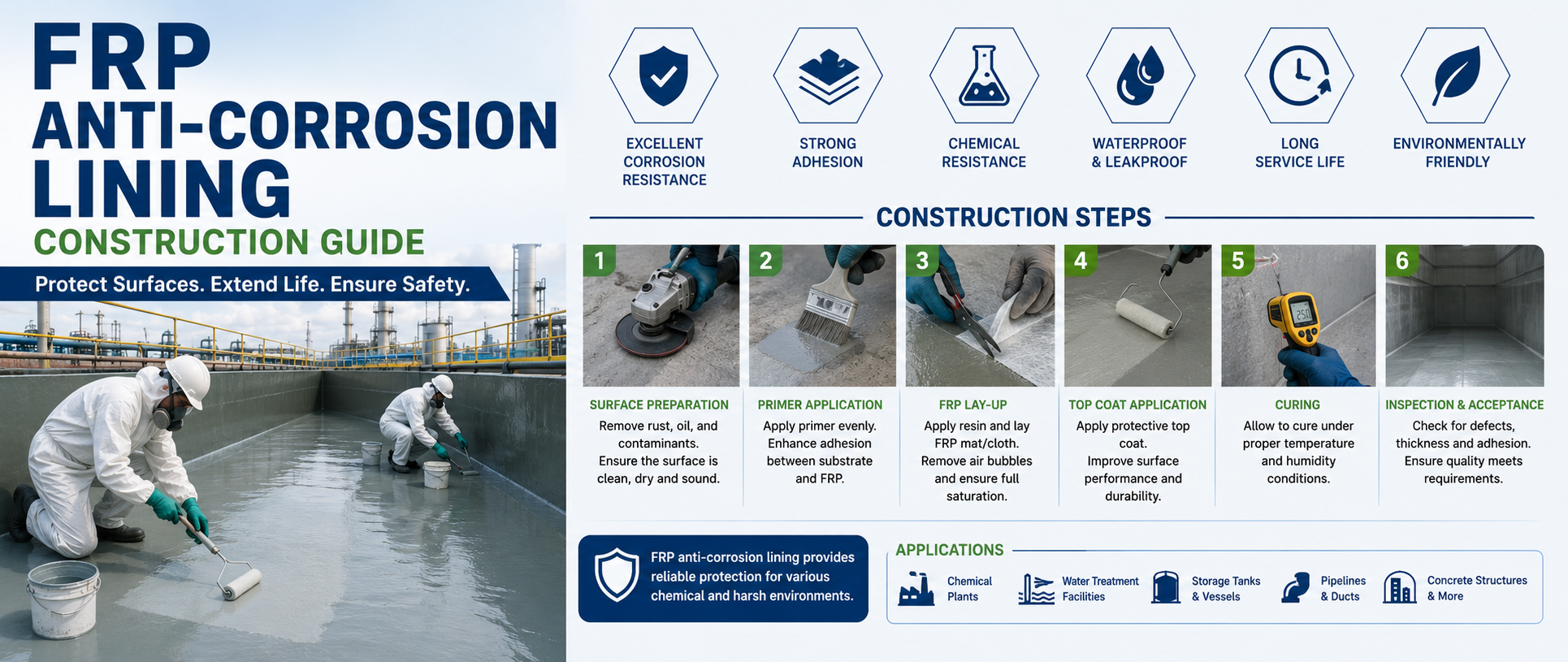
Anti-Corrosion Solutions for Different Industrial Equipment
In the chemical, petrochemical, pharmaceutical, wastewater treatment and heavy manufacturing industries, equipment internal corrosion is one of the most common and costly operational problems. For industrial owners and engineering contractors, adopting reliable FRP anti-corrosion lining has become the most practical way to extend equipment service life, reduce downtime and lower long-term maintenance costs. A high-quality FRP lining construction project not only relies on premium raw materials but also requires standardized processes, strict acceptance standards, professional anti-corrosion detection and systematic later maintenance. This complete guide focuses on mainstream industrial equipment, including storage tanks and reaction kettles, to deliver tailored FRP anti-corrosion lining solutions for different corrosive working conditions.
1. Main FRP Anti-Corrosion Lining Material Classifications and Application Scenarios
The selection of FRP anti-corrosion lining materials is the foundation of successful anti-corrosion construction. Different resin-based FRP lining materials feature distinct chemical resistance, temperature resistance and mechanical properties, which determine the applicability for various industrial equipment and corrosive media. The three most widely used FRP lining types in industrial anti-corrosion projects are as follows:
1.1 Epoxy Resin FRP Anti-Corrosion Lining
Epoxy-based FRP lining is famous for ultra-strong substrate adhesion, excellent waterproof performance and stable resistance to dilute acid, dilute alkali and salt solution corrosion. This type of FRP anti-corrosion lining fits perfectly with metal and concrete equipment surfaces, showing stable performance under medium and low temperature working environments. With high cost performance and reliable bonding strength, epoxy FRP lining is the preferred material for conventional industrial tank and equipment anti-corrosion lining projects.
1.2 Vinyl Ester Resin FRP Anti-Corrosion Lining
Vinyl ester FRP anti-corrosion lining belongs to high-performance industrial anti-corrosion materials, designed for harsh corrosive environments. It delivers outstanding resistance to strong acid, strong alkali, organic solvents and high-temperature medium erosion, and can stably operate under 80℃ to 120℃ high-temperature conditions. For reaction kettles and chemical storage tanks that contact aggressive chemical media continuously, vinyl ester FRP lining is the most reliable anti-corrosion lining choice to avoid rapid equipment corrosion failure.
1.3 Unsaturated Polyester Resin FRP Anti-Corrosion Lining
Unsaturated polyester FRP lining features flexible construction procedures and fast curing speed, suitable for large-area and short-cycle anti-corrosion lining construction. It has good tolerance to atmospheric corrosion, weak acid and weak alkali media, and is widely applied in environmental protection equipment, water treatment storage tanks and outdoor industrial equipment with relatively mild corrosion intensity. This FRP lining material balances construction efficiency and basic anti-corrosion performance for general industrial anti-corrosion demands.
2. Standard FRP Lining Construction Process for Storage Tanks & Reaction Kettles
Different industrial equipment has unique structural design, operating modes and corrosion characteristics, which means unified FRP lining construction processes cannot achieve optimal anti-corrosion effects. Targeted construction procedures for storage tanks and reaction kettles, the two most widely used industrial equipment, are standardized below to ensure high-quality FRP anti-corrosion lining molding.
2.1 FRP Anti-Corrosion Lining Construction for Industrial Storage Tanks
Industrial storage tanks are mainly used for long-term static storage of chemical raw materials, industrial wastewater, petroleum products and corrosive solution media, suffering from long-term uniform internal corrosion. The FRP lining construction for storage tanks focuses on thorough surface pretreatment, integral dense lining laying and seamless anti-leakage treatment.
The whole standardized FRP lining construction flow starts with tank inner wall pretreatment. Workers conduct professional sandblasting and polishing to completely remove surface rust, oxide scale, oil contaminants and residual impurities, ensuring the substrate roughness meets the bonding requirements of FRP anti-corrosion lining materials. Next, professional primer matching the stored corrosive medium is evenly coated on the tank wall to strengthen the bonding force between the substrate and FRP lining layer. After primer full curing, glass fiber reinforcement cloth and resin glue are laid layer by layer, with strict bubble and wrinkle elimination treatment to ensure the compactness of the FRP anti-corrosion lining structure. Finally, a finish anti-corrosion coating is applied, followed by sufficient natural curing to complete the whole storage tank FRP lining construction.
2.2 FRP Anti-Corrosion Lining Construction for Chemical Reaction Kettles
Different from static storage tanks, chemical reaction kettles work under dynamic conditions including high-temperature reaction, medium stirring, pressure fluctuation and mechanical friction, bearing dual damage of chemical corrosion and physical wear. Thus, the FRP lining construction for reaction kettles has stricter standards for wear resistance, impact resistance and structural stability of FRP anti-corrosion lining.
On the basis of standard degreasing and rust removal pretreatment, the FRP lining construction for reaction kettles adds fine polishing for weld joints, dead corners and edge positions to eliminate hidden corrosion gaps. A multi-layer composite FRP anti-corrosion lining structure is adopted: the bottom primer layer enhances substrate adhesion, the middle multi-layer glass fiber structure improves mechanical strength and anti-impact performance, and the surface high-density resin layer resists strong chemical medium corrosion. During the whole construction process, each laying layer is rolled and defoamed in real time to avoid structural defects. After construction, targeted high-temperature curing is carried out according to actual operating conditions to improve the overall stability of the reaction kettle FRP lining.
3. Industrial-Grade Acceptance Standards for FRP Anti-Corrosion Lining Construction
To guarantee the long-term anti-corrosion performance and service life of newly completed FRP lining construction projects, full-standard acceptance inspection must be implemented in accordance with industrial specifications, covering appearance quality, lining thickness, structural compactness and bonding performance of FRP anti-corrosion lining.
In terms of appearance acceptance, the FRP lining surface must be smooth and flat without cracks, penetrating pinholes, bubbles, peeling and uneven coating defects, with smooth transition at equipment corners and welds. For thickness inspection, professional thickness detectors are used for multi-point random sampling on the equipment inner wall to ensure the actual thickness of FRP anti-corrosion lining fully meets the design standard without local thin layers. In compactness testing, full-coverage spark leakage detection is mandatory to ensure no leakage or breakdown points on the entire lining surface. Meanwhile, sampling pull-off tests are conducted to verify the bonding strength between FRP lining and equipment substrate, avoiding delamination and peeling risks in later operation.
4. Professional Detection Methods for FRP Anti-Corrosion Lining Operational Effect
Regular anti-corrosion effect detection is an essential measure to monitor the operating state of FRP anti-corrosion lining, eliminate potential corrosion hazards and judge lining aging degree during long-term equipment operation. The mainstream professional detection methods for FRP lining construction quality and later operational effect are as follows:
First, routine visual inspection: regularly check the FRP lining surface for aging discoloration, fine cracks, local peeling and corrosion traces, focusing on high-risk areas such as equipment bottom, medium liquid level line and weld joints. Second, ultrasonic thickness detection: periodically measure the residual thickness of FRP anti-corrosion lining to evaluate material wear and aging degree and predict residual service life. Third, tightness and insulation detection: use professional instruments to detect the overall compactness of the lining layer to prevent micro-leakage induced substrate corrosion. Fourth, medium resistance performance test: conduct regular sampling analysis for FRP lining materials in high-corrosion working conditions to verify long-term anti-corrosion stability.
5. Practical Later Maintenance Skills for FRP Anti-Corrosion Lining
Scientific daily maintenance is key to extending the service life of FRP anti-corrosion lining and maximizing the value of FRP lining construction projects. Standardized maintenance can effectively avoid premature aging, damage and failure of the lining, reducing enterprise equipment renovation and maintenance costs.
First, stabilize equipment operating conditions. Avoid rapid temperature and pressure fluctuation, frequent overload operation and extreme working condition switching for storage tanks and reaction kettles, to prevent FRP anti-corrosion lining cracking and delamination caused by thermal expansion and contraction stress. Second, implement regular professional cleaning. Clean residual corrosive media, sediment and attachments on the FRP lining surface regularly with soft cleaning tools to avoid local accelerated aging caused by long-term medium adhesion. Third, establish periodic inspection and timely repair mechanism. Quickly repair small-area pinholes, fine cracks and thin lining layers detected in daily inspection to prevent defect expansion and large-area lining damage. Fourth, standardize idle equipment maintenance. Keep the internal environment of idle equipment dry and ventilated to prevent FRP anti-corrosion lining from mildewing, aging and performance degradation in humid corrosive atmosphere.
6. Conclusion
FRP anti-corrosion lining is a systematic and high-efficiency industrial anti-corrosion solution widely used in storage tanks, reaction kettles and various corrosive industrial equipment. The final anti-corrosion effect and service life depend on reasonable material selection, standardized FRP lining construction technology, strict project acceptance, regular professional detection and refined daily maintenance. For different industrial equipment and working conditions, targeted customized FRP anti-corrosion lining schemes must be adopted to ensure equipment long-term safe and stable operation, effectively reduce industrial equipment corrosion risks, and create stable economic benefits for industrial production.