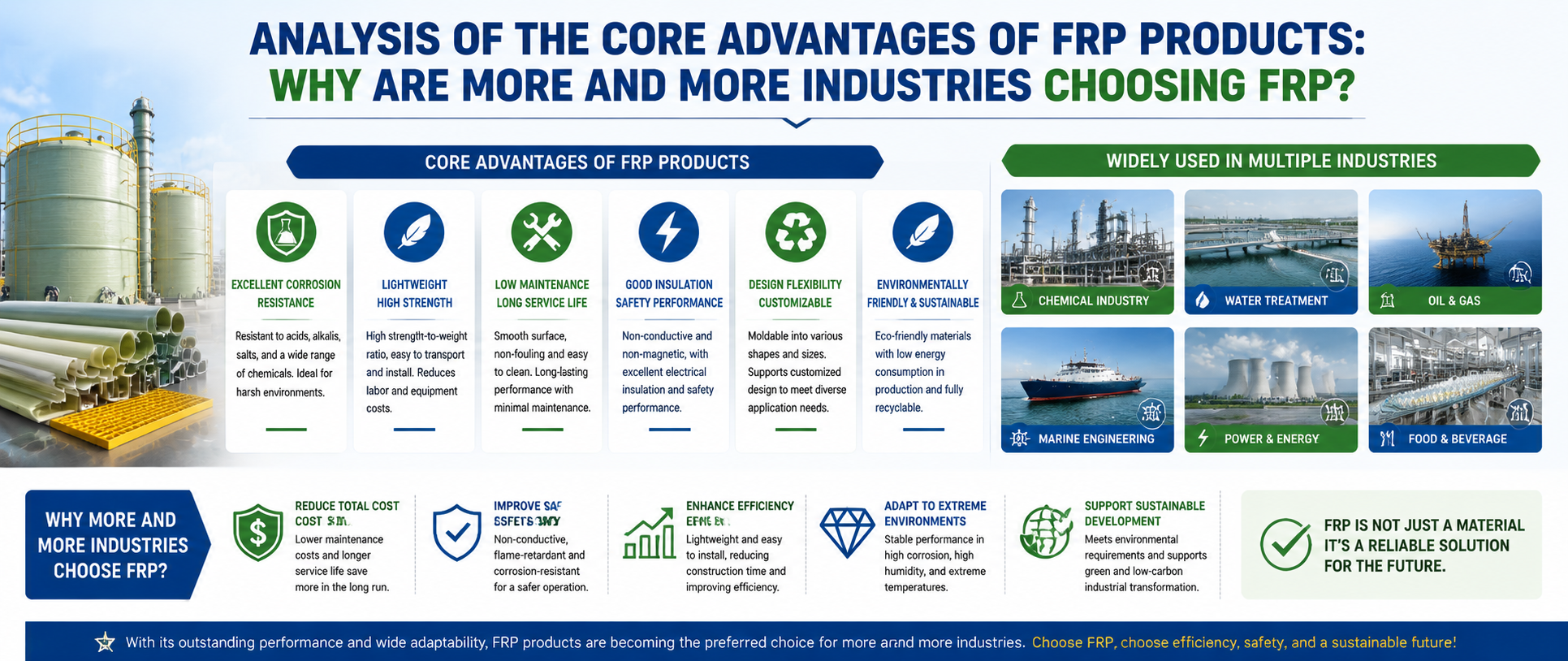
In various fields such as industrial manufacturing, municipal construction, new energy, and marine engineering, a new type of composite material is gradually replacing traditional materials such as steel, concrete, and plastics, becoming the industry's "new favorite"—this is fiberglass reinforced plastic (FRP). Unlike the limitations of traditional single materials, FRP uses glass fiber as the reinforcing material and resin as the matrix, combining the core advantages of multiple materials while
Advantage 1: Superior Corrosion Resistance, Adaptable to Harsh Working Conditions, Significantly Reduced Maintenance Costs
Corrosive media (acids, alkalis, salts, wastewater, seawater, etc.) are the "natural enemies" of traditional materials: steel corrodes rapidly upon prolonged contact with acids and alkalis, resulting in a very high percentage of annual losses due to corrosion; concrete is prone to weathering and cracking in saline-alkali soils and chemical environments; ordinary plastics cannot withstand the erosion of high temperatures and strong corrosive media, leading to a short service life. One of the core advantages of fiberglass is its all-around corrosion resistance. Its matrix resin has excellent chemical stability, while glass fiber provides reinforcement and support. The combination of these two components can resist the erosion of most acids, alkalis, salts, organic solvents, seawater, and other media, eliminating the need for additional anti-corrosion treatment.
Industry Case Study: A chemical company's acid and alkali wastewater treatment system previously used stainless steel pipes, which developed rust and leaks in less than a year, resulting in annual maintenance and replacement costs reaching hundreds of thousands of yuan. After switching to fiberglass pipes, it has maintained its system without any corrosion or leaks for five consecutive years, reducing maintenance costs by over 90%, requiring only periodic cleaning, and significantly minimizing downtime losses. Furthermore, in marine engineering, fiberglass railings and platform supports are immune to seawater corrosion, boasting a service life exceeding 20 years, far surpassing the 5-8 years of steel.
Compared to traditional materials: fiberglass's corrosion resistance is more than 10 times that of steel and 3-5 times that of ordinary plastics, making it particularly suitable for harsh environments such as chemical plants, marine environments, municipal wastewater treatment, and electroplating. In the long term, it completely avoids the pain points of frequent replacements and repeated maintenance, highlighting its cost-effectiveness advantage.
Advantage Two: Lightweight design facilitates transportation and installation, reducing overall construction costs.
Traditional materials generally suffer from being bulky: steel has a high density, approximately 7.85 tons per cubic meter; concrete has a density of approximately 2.4 tons per cubic meter. Transporting and hoisting large components requires specialized equipment, leading to increased construction difficulty and costs. Even ordinary plastics require increased thickness to achieve the same strength, resulting in increased weight. Fiberglass, with a density of only 1.5-2.0 tons per cubic meter, is only 1/4-1/5 the density of steel and 1/2 the density of concrete. While maintaining strength, it allows for lightweight design, significantly reducing transportation and installation costs.
Industry Case Study: Previously, photovoltaic (PV) support structures for a new energy power station used galvanized steel, with each support weighing 80kg. Large trucks were required for transportation, and cranes were needed for on-site installation, resulting in low construction efficiency and high risks associated with working at heights. After switching to fiberglass PV support structures, each support weighs only 25kg, allowing for manual handling and installation without large equipment. Transportation costs were reduced by 60%, construction efficiency increased by more than three times, and safety hazards associated with working at heights were reduced. Furthermore, in the aerospace and rail transportation sectors, the application of fiberglass components can effectively reduce equipment weight and lower energy consumption.
Compared to traditional materials, fiberglass's lightweight advantages not only reduce labor and equipment costs for transportation, hoisting, and construction, but also reduce the load-bearing pressure on building structures (such as municipal manhole covers and bridge railings). It is particularly suitable for scenarios where construction is inconvenient, such as high-altitude or remote areas, resulting in a 30%-50% reduction in overall construction costs.
Advantage Three: Easy Customization, Flexible Molding, Adaptable to Complex Scenarios, No Complex Processing Required
The molding and processing of traditional materials are limited by their inherent characteristics: steel requires cutting, welding, and grinding, resulting in complex processes and difficulty in molding complex curved surfaces; concrete cannot be modified after molding, leading to poor adaptability; plastic molding is limited by molds, making it difficult to achieve complex structures. In contrast, fiberglass offers flexible and diverse molding processes (hand lay-up, spraying, compression molding, pultrusion, etc.), allowing for the customization of products of any shape, size, and thickness according to customer needs. Whether it's complex curved components, irregularly shaped pipes, or customized equipment shells, they can all be molded in one go, eliminating the need for complex subsequent processing and significantly shortening the production cycle.
Industry Case Study: An environmental protection company needed to customize a set of irregularly shaped wastewater treatment tanks. The tanks had irregular shapes and required multiple interfaces. Traditional concrete pouring couldn't achieve such complex designs, while steel welding suffered from poor sealing and corrosion. Using fiberglass hand lay-up molding, the customized production was completed in just 7 days. The tanks were seamlessly connected, with excellent sealing performance. Furthermore, the thickness and interface positions could be flexibly adjusted according to wastewater treatment needs. Compared to traditional materials, the production cycle was shortened by 60%, and customization costs were reduced by 40%. In addition, fiberglass can be molded into various complex shapes in landscape sculptures and amusement facilities, combining aesthetics and durability.
Comparison with Traditional Materials: The customization advantages of fiberglass perfectly adapt to the complex scenarios of various industries, requiring no additional processing steps. It meets personalized needs while shortening the production cycle and reducing customization costs, solving the pain points of traditional materials such as "difficult molding and poor adaptability."
Advantage Four: High Strength, Good Toughness, Impact Resistance, Aging Resistance, and Long Service Life
Many people mistakenly believe that "lightweight" means "low strength," but fiberglass (FRP) defies this perception. Its tensile and flexural strength are comparable to steel, and some high-performance FRPs even surpass ordinary steel in strength. Simultaneously, it possesses excellent toughness, is not easily broken or deformed, and exhibits superior impact resistance. Furthermore, FRP has excellent anti-aging properties, resisting ultraviolet radiation and weathering, and is not prone to fading or embrittlement. In outdoor environments, its service life can reach 15-20 years, and under certain conditions, even exceeding 30 years.
Industry Case Study: Previously, a municipal road's guardrails were made of cement, which was hard but lacked toughness, easily breaking after vehicle impacts and difficult to repair. After switching to FRP guardrails, they were not only lighter and easier to install, but also able to withstand greater impact forces. After a vehicle impact, they only showed slight deformation, requiring no complete replacement, resulting in low repair costs. Their service life reached 20 years, far exceeding the 8-10 years of cement guardrails. In the mining industry, fiberglass reinforced plastic (FRP) mining supports replace traditional steel supports, not only meeting strength requirements but also resisting underground impacts and corrosion, reducing the risk of support collapse.
Compared to traditional materials, FRP's "high strength + high toughness" avoids the shortcomings of steel's susceptibility to deformation, plastic's susceptibility to breakage, and concrete's susceptibility to cracking, while also improving durability. In the long run, this reduces product replacement frequency, further lowering overall costs.
Advantage Five: High overall cost-effectiveness, reasonable initial investment, and significant long-term benefits
Many companies, when selecting FRP, are concerned about the slightly higher initial investment compared to ordinary plastics and concrete, but overlook its long-term benefits. In fact, FRP's "high cost-effectiveness" is reflected in the reduction of its "total life cycle cost"—while the initial investment is slightly higher, it requires no anti-corrosion treatment, has extremely low maintenance costs, and a long service life. Overall, the total life cycle cost is far lower than that of traditional materials.
"Cost Comparison": Taking municipal sewage pipelines as an example, a 1-kilometer DN500 pipe requires an initial investment of approximately 800,000 yuan for steel pipes, with annual maintenance costs of approximately 50,000 yuan and a service life of approximately 8 years, resulting in a total life-cycle cost of approximately 1.2 million yuan. Fiberglass (FRP) pipes, on the other hand, require an initial investment of approximately 1 million yuan, with annual maintenance costs of approximately 5,000 yuan and a service life of approximately 20 years, resulting in a total life-cycle cost of only approximately 1.1 million yuan. While the initial investment may seem 200,000 yuan more, in the long run, it actually saves 100,000 yuan and reduces indirect losses by eliminating the need for frequent downtime for maintenance.
Furthermore, FRP has excellent insulation and sound insulation properties, making it suitable for power, communication, and building soundproofing applications without the need for additional insulation or soundproofing layers, further reducing supporting costs. Simultaneously, FRP is recyclable, meeting environmental protection requirements, reducing resource waste, and saving companies on environmental protection investments.
Summary: The core competitiveness of FRP is "versatility + long-term cost savings."
From corrosion resistance and lightweight to easy customization, high strength, and high cost-effectiveness, FRP's five core advantages precisely address the pain points of traditional materials in various industries. Unlike steel, which is prone to corrosion and heavy, or concrete, which is difficult to mold and has poor toughness, or ordinary plastics, which have low strength and short lifespan, FRP combines the advantages of multiple materials, achieving a comprehensive advantage of "comprehensive performance, controllable cost, and strong adaptability."
Today, with the continuous improvement of product performance, cost control, and environmental protection requirements across industries, FRP has been widely used in chemical, municipal, new energy, marine engineering, aerospace, and mining fields, becoming a "preferred material" for industry upgrades. For enterprises, choosing FRP is not only choosing a high-quality product, but also choosing a "long-term cost-effective, worry-free, and efficient" solution—this is the core reason why more and more industries are abandoning traditional materials and firmly choosing FRP.
If your industry is facing problems such as material corrosion, inconvenient transportation, difficulty in customization, and high maintenance costs, you might consider FRP products; they may bring you unexpected benefits.