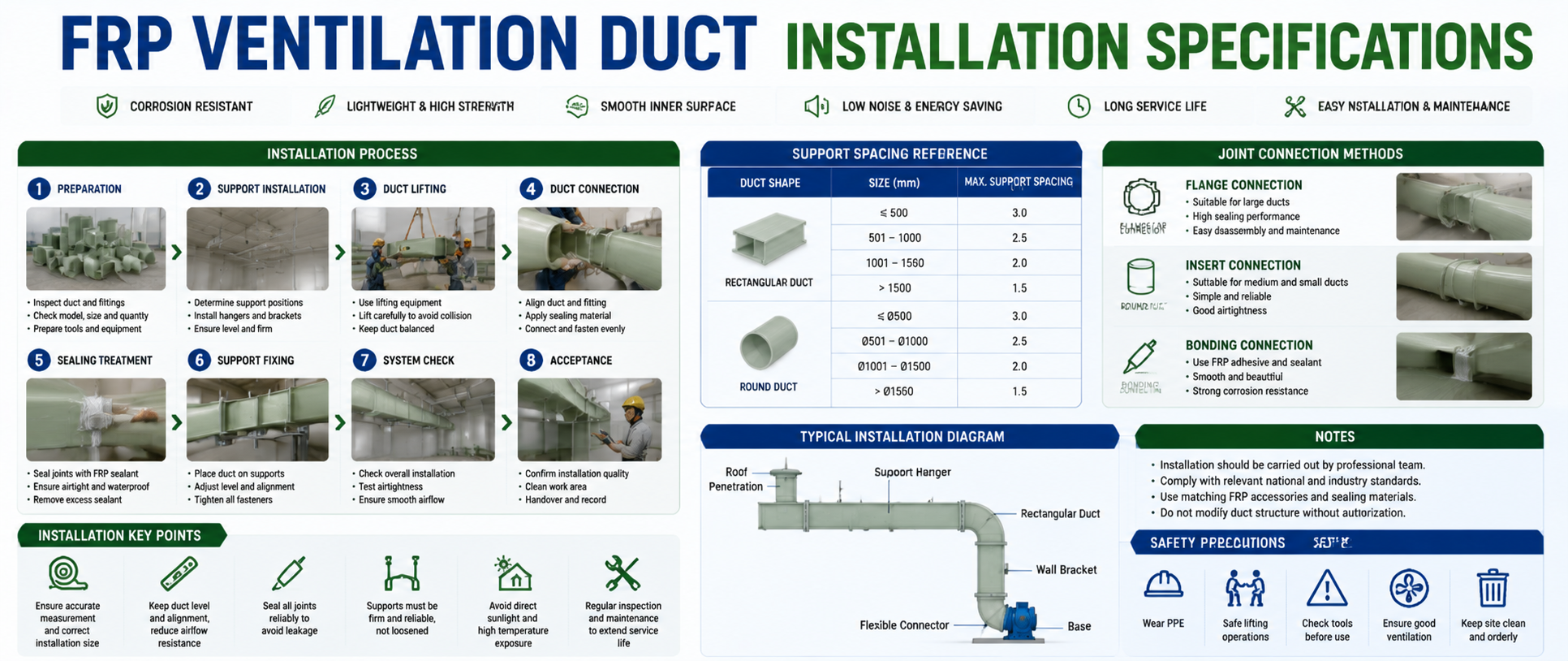
Ultimate Guide to Air Resistance Control & Sealing Techniques
Core Keywords: FRP ventilation duct, fiberglass duct installation, duct air resistance control, HVAC duct sealing techniques, FRP duct sizing specification, leak-proof ventilation duct installation, FRP duct maintenance, industrial ventilation system
Meta Description: Master professional FRP ventilation duct installation specifications, including scientific duct sizing, effective air resistance control methods, standard splicing skills, leak-proof sealing techniques, daily maintenance, and multi-scene adaptation solutions for industrial and commercial HVAC ventilation systems.
FRP (Fiberglass Reinforced Plastic) ventilation ducts have become a mainstream choice for modern industrial, commercial, and civil ventilation systems due to their outstanding corrosion resistance, lightweight structure, low noise, long service life, and stable airflow performance. Compared with traditional galvanized steel ducts, FRP ventilation ducts feature better anti-aging properties, lower operational wind resistance, and stronger environmental adaptability, making them widely used in chemical plants, pharmaceutical factories, shopping malls, underground garages, and sewage treatment workshops. However, the overall performance of FRP duct systems heavily relies on standardized installation processes. Unreasonable size selection, improper air resistance control, unstandardized splicing, or incomplete sealing will lead to increased energy consumption, air leakage, airflow disorder, and even shortened service life of the entire ventilation system. This guide comprehensively sorts out authoritative FRP ventilation duct installation specifications, focusing on core technologies of air resistance control and leak-proof sealing, and provides systematic installation, maintenance, and scene adaptation guidelines for engineering constructors and HVAC practitioners.
1. Scientific FRP Ventilation Duct Sizing Selection (Core Specification)
Duct sizing is the foundation of controlling system wind resistance and ensuring stable ventilation efficiency. Most FRP ventilation system operational problems stem from unscientific initial size matching. Strictly following industry installation specifications to select duct diameter, cross-sectional shape, and wall thickness is the primary step to optimize airflow and reduce energy loss.
1.1 Shape Selection & Size Matching Principles
FRP ventilation ducts are mainly divided into round FRP ducts and rectangular FRP ducts, with distinct application scenarios and wind resistance characteristics. Round FRP ducts feature smoother inner walls, shorter airflow perimeter, lower turbulence coefficient, and minimal wind resistance, making them the preferred choice for long-distance ventilation and high-air-volume systems. Rectangular FRP ducts are suitable for narrow installation spaces such as ceiling interlayers due to their space-saving advantages, but they have relatively higher local wind resistance and require stricter structural optimization during installation.
In accordance with HVAC duct design specifications, duct size selection must be based on actual ventilation volume, pipeline length, and wind speed standards. For conventional industrial ventilation systems, the recommended wind speed of main FRP ducts is 6–10m/s, and branch ducts are controlled at 3–6m/s. Excessively high wind speed will sharply increase frictional wind resistance and generate airflow noise; excessively low wind speed will lead to oversized ducts, increasing installation costs and occupying extra space. Meanwhile, avoid sudden diameter changes in duct pipelines. Abrupt cross-section transitions will form turbulent airflow, greatly improving local wind resistance and reducing ventilation efficiency.
1.2 Wall Thickness & Structural Sizing Specifications
The wall thickness of FRP ventilation ducts must match the system operating pressure and installation environment. For conventional low-pressure ventilation systems (static pressure ≤500Pa), the recommended duct wall thickness is 3–5mm; for medium and high-pressure industrial ventilation systems (static pressure 500–1500Pa) and corrosive environments such as chemical workshops, the wall thickness should be increased to 5–8mm to ensure structural stability and prevent duct deformation caused by air pressure impact. In addition, when the straight-line length of FRP ducts exceeds 20 meters, auxiliary fixing supports must be added, and expansion joints should be configured according to design standards to avoid pipeline deformation and joint cracking caused by thermal expansion and contraction, which affects wind resistance stability and sealing performance.
2. Professional Air Resistance Control Methods for FRP Ventilation Ducts
Duct air resistance is the core factor affecting the operating efficiency and energy consumption of ventilation systems. Wind resistance is mainly divided into frictional resistance (generated by airflow friction with the duct inner wall) and local resistance (generated by pipeline bending, branching, diameter change, and equipment connection). Standardized installation and optimized pipeline layout can effectively reduce wind resistance loss by 15%–30% and significantly improve ventilation system operating efficiency.
2.1 Frictional Wind Resistance Optimization
The smooth inner wall of FRP ducts is its inherent advantage over metal ducts, but improper transportation, cutting, and installation will damage the inner wall flatness and increase frictional resistance. During construction, avoid scratching, denting, or polluting the inner wall of FRP ducts; cut ducts with professional tools to ensure smooth and burr-free cutting sections. All pipeline connections must maintain flat inner wall transition without protruding joints or adhesive residues. Regular cleaning of duct inner wall dust and attachments during later operation can prevent increased surface roughness and effectively stabilize low wind resistance performance for a long time.
2.2 Local Wind Resistance Reduction Techniques
Local wind resistance is the main source of system wind resistance loss, and standardized layout of key pipeline nodes is crucial. First, reduce sharp bends in pipelines as much as possible. All turning parts should adopt arc transition elbows with a bending radius ≥1.5 times the duct diameter to avoid airflow turbulence and vortex generation. Second, when pipelines need diameter reduction or expansion, use gradual reducing joints instead of sudden diameter changes to ensure smooth airflow transition and reduce local pressure loss.
In addition, the branching design of FRP ducts should follow the principle of uniform shunting. Avoid right-angle shunting which causes severe airflow impact. Adopt oblique shunting structures to ensure balanced airflow of each branch and reduce resistance loss caused by airflow collision. For long-distance ventilation pipelines, reasonably set fixed supports and hanging points to prevent duct sagging and deformation, which will cause pipeline bending and increased wind resistance.
3. Standard FRP Ventilation Duct Installation & Splicing Skills
Duct splicing quality directly determines the structural stability and sealing effect of the entire ventilation system. FRP ducts are mostly connected by flange connection and socket bonding. Strictly following FRP duct installation specifications for standardized splicing is the key to avoiding duct deformation, air leakage, and increased wind resistance.
3.1 Flange Connection Standard Process
Flange connection is the most widely used splicing method for large-diameter and high-air-tightness FRP ducts. First, check the flatness of duct flanges before installation to ensure no deformation, cracks, or damage. When aligning the two sections of ducts, keep the flange faces parallel and the duct axis consistent to avoid dislocation and uneven joints. Lay special flame-retardant and corrosion-resistant gaskets (asbestos rope, 8501 adhesive strip) evenly between flanges, with flat paving without distortion, overlap, or outer protrusion, ensuring full contact and filling of gaps.
Use galvanized bolts for flange fastening, with uniform bolt direction and symmetric and gradual fastening. Avoid one-sided excessive fastening which causes flange deformation and gap leakage. After fastening, ensure all gaskets are tightly compressed without gaps, and the inner wall of the joint is flat and smooth to prevent protruding structures from increasing wind resistance. For ducts passing through building expansion joints, flexible connectors must be used for transition, with the flexible hose length matching the expansion joint width plus 100mm to adapt to building displacement and protect duct joints.
3.2 Socket Bonding Splicing Technology
Socket bonding is suitable for small-diameter FRP ventilation ducts and low-pressure ventilation systems. Before bonding, polish the socket and outer wall of the duct to remove dust, oil, and burrs to ensure a dry and clean bonding surface. Prepare special FRP resin putty according to the standard ratio, fill the joint gaps completely, and ensure no voids or bubbles inside. After butt-jointing the ducts, fix them with temporary supports, and remove excess adhesive to keep the inner wall smooth. After the adhesive is fully cured (curing time ≥24 hours at normal temperature), conduct a stability test to ensure the joints are firm and free of looseness.
4. Core Leak-Proof Sealing Techniques for FRP Ducts
Air leakage is a common failure of FRP ventilation systems. Unqualified sealing of joints, flanges, and wall penetration parts will cause serious air leakage, reduce ventilation efficiency, increase equipment energy consumption, and even lead to dust and moisture infiltration to corrode the duct structure. Scientific and standardized sealing construction is an essential link in FRP duct installation specifications.
4.1 Joint & Flange Sealing Treatment
On the basis of standard flange fastening and socket bonding, secondary sealing reinforcement is required for all joints. For flange gaps, apply high-ductility duct mastic evenly on the inner and outer sides, and paste aluminum foil sealing tape after smoothing to form a double-layer leak-proof structure. For socket bonding joints, after the resin putty is cured, fill the tiny gaps with waterproof and air-tight sealant to eliminate hidden air leakage dangers. Round FRP ducts have simpler flange structures and shorter perimeters, with better natural sealing effects; rectangular FRP ducts need full sealing treatment on four sides of flanges to avoid dead-angle air leakage.
4.2 Special Position Sealing Specifications
The wall penetration parts of FRP ducts are high-frequency air leakage points. After the duct passes through the wall or floor, fill the gap between the duct and the hole tightly with fireproof and air-tight filling materials, and seal the inner and outer sides with sealant to ensure complete closure. The connection between ducts and fans, air valves, and other equipment must adopt flexible sealing connections to avoid air leakage caused by vibration friction. In addition, install isolation dampers with standard leakage rates at key positions. The maximum air leakage rate must meet AMCA industry standards to ensure the overall air tightness of the system.
5. Daily Cleaning & Maintenance of FRP Ventilation Ducts
Scientific daily maintenance can effectively extend the service life of FRP ventilation ducts, stabilize low wind resistance and high air-tightness performance, and avoid system failures caused by long-term operation. FRP ducts have corrosion-resistant and dust-resistant advantages, but regular maintenance is still indispensable.
5.1 Regular Cleaning Standards
Formulate a targeted cleaning cycle according to the operating environment: clean the inner wall of ducts every 3–6 months for ordinary commercial environments such as shopping malls and office buildings; clean industrial ducts in chemical, pharmaceutical, and dust workshops every 1–3 months. Use dry brushing, vacuum cleaning or low-pressure air blowing for cleaning to avoid scratching the inner wall of FRP ducts. For stubborn attachments, use neutral detergent for wiping, and ensure the inner wall is dry after cleaning to prevent mold and corrosion. It is strictly forbidden to step on or squeeze the duct during cleaning to avoid structural deformation and sealing damage.
5.2 Routine Inspection & Maintenance
Check the tightness of duct joints, flanges, and sealing tapes monthly to repair loose sealant and fallen tapes in time. Inspect the fixing supports and hanging points of long-distance pipelines to prevent pipeline sagging and joint cracking. Regularly test the system wind speed and air volume. If the wind resistance increases abnormally and ventilation efficiency decreases, check for duct deformation, inner wall scaling, or local blockages. For aging and cracked sealing parts, replace them in time to maintain the long-term air tightness of the system.
6. Multi-Scenario Adaptation Suggestions for FRP Ventilation Duct Installation
Different application scenarios have distinct requirements for duct wind resistance, sealing performance, and installation standards. Targeted optimization of installation processes according to scenario characteristics can maximize the performance advantages of FRP ventilation systems.
6.1 Industrial Corrosive Environment (Chemical/Sewage Workshop)
Such scenarios are characterized by humid air and corrosive gas. It is necessary to select thickened anti-corrosion FRP ducts, optimize the pipeline layout to reduce bending nodes and wind resistance loss, and adopt double-layer sealing processes for all joints. Increase the density of fixing supports for long-distance pipelines, and add anti-corrosion coatings on the outer wall of ducts to avoid environmental corrosion damage. Shorten the maintenance cycle and focus on checking joint sealing and inner wall corrosion.
6.2 Commercial Civil Scenarios (Mall/Office Building/Underground Garage)
Commercial scenarios focus on low noise, low energy consumption, and beautiful installation. Prioritize round FRP ducts with low wind resistance, optimize pipeline bending and branching layout to reduce airflow noise. Strictly control the air tightness of the system to avoid air leakage causing uneven indoor ventilation. Adopt hidden installation, standardize the spacing of hanging supports, and ensure the neat and stable pipeline layout.
6.3 High-Precision Scenarios (Pharmaceutical/Electronic Dust-Free Workshop)
Dust-free workshops have extremely high requirements for system air tightness and wind resistance stability. Adopt fully sealed socket bonding + flange double sealing process to achieve zero air leakage of the system. Optimize the pipeline layout to ensure uniform wind speed and stable pressure, avoid local wind resistance fluctuation affecting indoor air quality. Conduct regular professional air tightness testing and wind resistance parameter calibration to meet dust-free workshop operation standards.
7. Summary
The installation quality of FRP ventilation ducts determines the operational efficiency, energy consumption, and service life of the entire HVAC ventilation system. Scientific size selection is the foundation of wind resistance control, standardized pipeline layout and node optimization are the core of reducing wind resistance loss, professional splicing and multi-layer sealing technology are the key to solving air leakage problems, and regular cleaning and maintenance are the guarantee of long-term stable system operation. Combined with the differentiated installation requirements of industrial, commercial, and dust-free scenarios, strictly following industry installation specifications and adopting refined construction techniques can give full play to the advantages of FRP ducts such as low wind resistance, anti-corrosion, and high air tightness, and create efficient, energy-saving, and stable ventilation systems for various engineering projects.
Long-Tail Keywords: fiberglass duct wind resistance optimization, FRP duct leak-proof sealing guide, industrial FRP ventilation duct installation standard, HVAC fiberglass duct maintenance tips, FRP duct size selection for ventilation system