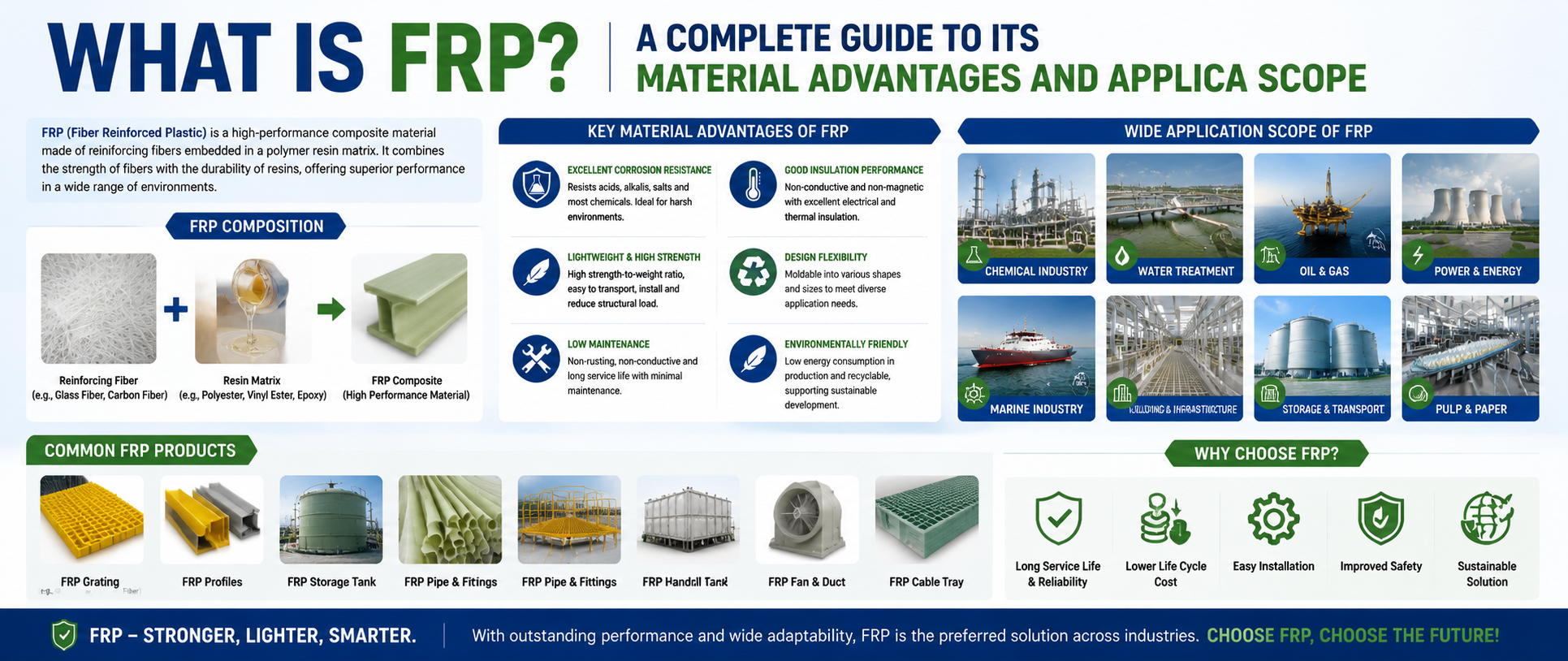
When it comes to FRP (Fiberglass Reinforced Plastic), many people mistakenly think it is "glass + steel". In fact, it is neither glass nor steel, but an advanced composite material with comprehensive performance. With its core advantages such as corrosion resistance, lightweight, and easy molding, FRP material has now widely replaced metals and ordinary plastics, penetrating chemical industry, environmental protection, transportation, construction, new energy and other industries, becoming an in
I. What is FRP (Fiberglass Reinforced Plastic)? Analysis of Material Composition
FRP, formally known as Glass Fiber Reinforced Plastic, is a new type of composite material composed of reinforcing materials + matrix materials. Its principle is similar to "reinforced concrete": glass fiber acts like steel bars to bear tensile load, and resin acts like cement to bond, fix and protect the fibers.
Reinforcing Materials: The core isglass fiber (glass fiber yarn, glass fiber cloth, chopped mat). Some high-end products use carbon fiber and aramid fiber to provide the strength and toughness of the material;
Matrix Materials: The mainstream is unsaturated polyester resin, epoxy resin, phenolic resin, which play the roles of bonding fibers, resisting chemical corrosion, waterproofing and insulating, and shaping;
Molding Process: Through hand lay-up, winding, pultrusion, compression molding, spraying and other processes, glass fiber and resin are cured and formed into various products such as pipes, storage tanks, gratings, profiles, and shells.
According to the type of resin, FRP is divided into three categories: polyester FRP (civilian and general use), epoxy FRP (high-end corrosion resistance), and phenolic FRP (high temperature resistance and flame retardancy), which are suitable for different working conditions.
II. FRP vs. Metal, Ordinary Plastic: Core Performance Comparison
In many scenarios, people are hesitant to choose steel, plastic or FRP. The core differences are clear at a glance:
Comparison Dimension | FRP (Fiberglass Reinforced Plastic) | Steel/Metal | Ordinary Engineering Plastics |
|---|---|---|---|
Weight | Density 1.4–1.9g/cm³, about 1/4–1/5 of steel, extremely lightweight FRP | High density, heavy weight, high transportation and installation costs | Lightweight but extremely low strength |
Strength | Tensile strength 150–450MPa, specific strength (strength/weight) far exceeds steel | High absolute strength but heavy weight and low specific strength | Poor strength, easy to deform and break |
Corrosion Resistance | Resistant to acid, alkali, salt spray, seawater, sewage, no rust, service life up to 20+ years | Easy to rust and corrode, quick failure in acid-base environment, high maintenance cost | Corrosion-resistant but not aging-resistant, easy to deform at high temperature |
Insulation | Completely insulated, non-conductive, non-magnetic | Conductive, easy to leak electricity and electromagnetic interference | Insulated but insufficient rigidity |
Moldability | Integrally moldable complex special-shaped parts, no welds, no gaps | Welding processing, extremely high cost for special-shaped parts | Simple molding, cannot be made into high-strength structural parts |
Maintenance Cost | Almost maintenance-free, long service life | Regular derusting, anti-corrosion, high maintenance cost | Easy to age and damage, frequent replacement |
To put it simply: metal excels in absolute high strength, plastic excels in low cost, while FRP balances lightweight, high strength, corrosion resistance and insulation, making it the optimal solution for harsh working conditions and lightweight scenarios.
III. 8 Core Advantages of FRP (Fiberglass Reinforced Plastic)
1. Lightweight and High Strength, Reduce Weight and Increase Efficiency
Its weight is only 1/4 of steel, and its strength is 3–4 times that of steel under the same weight. Used in ships, vehicles and wind turbine blades, lightweight FRP can greatly reduce weight, improve endurance, speed and wind energy efficiency, and reduce transportation and installation difficulty.
2. Super Corrosion Resistance, "Durable" in Harsh Environments
The resin matrix has extremely strong chemical stability. In acid, alkali, seawater, sewage, salt spray, chemical flue gas environments, it does not rust, age or leak. It is the preferred corrosion-resistant FRP material for chemical industry, sewage treatment and marine engineering.
3. Excellent Insulation and Wave Transparency, Safe and No Hidden Dangers
Completely insulated, non-conductive and non-magnetic, it does not interfere with electromagnetic waves. It is suitable for power communication, 5G radomes and radar equipment, eliminating the risk of electric leakage and electromagnetic interference. Insulated FRP is widely used in power infrastructure.
4. Strong Designability, Integral Molding Without Shortcomings
The ratio of glass fiber and resin can be adjusted according to needs to customize strength, temperature resistance and flame retardancy; complex curved surfaces and special-shaped structures can be formed in one time without welds and leaks, reducing parts and leakage risks. FRP molding is flexible and adaptable.
5. Weather and Aging Resistance, Long Service Life
It is UV-resistant and aging-resistant under outdoor exposure and humid environments. The service life in conventional environments is 15–30 years, which is far better than ordinary plastics and 2–3 times longer than that of metal anti-corrosion equipment. Long-life FRP reduces replacement costs.
6. Low Thermal Conductivity, Thermal Insulation
It has excellent thermal insulation performance and no cold bridge effect, which is suitable for HVAC pipelines, storage tanks and building envelopes, with good energy-saving effect. Thermal insulation FRP is an ideal material for energy-saving projects.
7. Non-toxic and Environmentally Friendly, Suitable for People's Livelihood Scenarios
Food-grade FRP is non-toxic and tasteless, does not pollute water quality, and can be used in drinking water equipment, aquaculture and sanitary ware.Food-grade FRP meets environmental protection and health standards.
8. Extremely Low Maintenance Cost, High Comprehensive Cost-Effectiveness
No derusting, painting or frequent maintenance is required, and the comprehensive cost in long-term use is far lower than that of metal equipment.Cost-effective FRP is favored by enterprises.
IV. Summary of FRP Full-Industry Application Scenarios (Covering 10 Fields)
1. Chemical Anti-Corrosion Industry (Core Traditional Field)
FRP storage tanks, chemical pipes, desulfurization towers, scrubbers, gratings, operating platforms, valves and pumps are used for storage and transportation of acids, alkalis, salts and organic solvents, replacing stainless steel and carbon steel to solve corrosion problems.
2. Environmental Protection and Water Treatment Industry
Integrated sewage pumping stations, septic tanks, sewage treatment tank covers, gratings, seawater desalination equipment and water purification pipes are anti-seepage, anti-corrosion and free of secondary pollution, suitable for municipal sewage, industrial wastewater and seawater treatment. FRP for water treatment is efficient and environmentally friendly.
3. Electric Power, Communication and New Energy
Cable trays, cable protection pipes, 5G radomes, FRP wind turbine blades, photovoltaic brackets and insulating poles are insulating, flame-retardant, wind-resistant and corrosion-resistant, suitable for new energy and power infrastructure.
4. Transportation Industry
Ships: FRP fishing boats, yachts, speedboats and marine decks, which are corrosion-resistant to seawater, lightweight and fast;
Land: High-speed rail interior parts, automobile bumpers, body shells and subway equipment parts, which reduce weight, noise and impact;
Aviation: Radomes and lightweight structural parts, which are wave-transparent, high-strength and resistant to extreme environments.
5. Construction and Municipal Engineering
Lighting tiles, decorative components, integral bathrooms, cooling towers, tree pool covers, rain grates, underground pipe gallery accessories and bridge panels are beautiful, durable, easy to install and maintenance-free. FRP for construction improves project efficiency.
6. Marine and Military Fields
Offshore platform anti-corrosion structures, marine aquaculture boxes and military lightweight accessories are resistant to seawater and salt spray corrosion, suitable for extreme marine environments. Military FRP meets high-strength and lightweight requirements.
7. Food and Pharmaceutical Industry
Food storage tanks, drinking water pipes, pharmaceutical anti-corrosion equipment and clean operation platforms are non-toxic, tasteless, easy to clean and corrosion-resistant. FRP for food and pharmaceutical complies with industry standards.
8. Agriculture, Forestry and Fishery
Aquaculture ponds, greenhouse frames and agricultural machinery shells are aging-resistant, corrosion-resistant and suitable for outdoor environments.FRP for agriculture is durable and cost-effective.
9. Culture, Sports and Leisure
Surfboards, snowboards, yachts, outdoor furniture and amusement facility shells have flexible shapes, light weight and durability. FRP for leisure is popular among consumers.
10. Military Industry and Aerospace
Rocket fairings, satellite antennas and military protective parts are high-strength, lightweight, high and low temperature resistant, and stable in wave transmission. Aerospace FRP supports the development of the aerospace industry.
V. Conclusion: Why is FRP More and More Popular?
From chemical anti-corrosion to people's livelihood infrastructure, from new energy to marine engineering, FRP (Fiberglass Reinforced Plastic) has achieved "replacing steel with plastic and replacing heavy with light" with its comprehensive advantages of lightweight, high strength, corrosion resistance, insulation, easy molding, long service life and low maintenance, perfectly solving the industry pain points of metal corrosion and insufficient plastic strength.
With the advancement of environmental protection, new energy and lightweight trends, the application scenarios of FRP continue to expand. It has become a core composite material for modern industrial upgrading and green infrastructure, and has great market potential in the future. If you are looking for high-quality FRP products or professional FRP solutions, FRP is definitely a reliable choice.