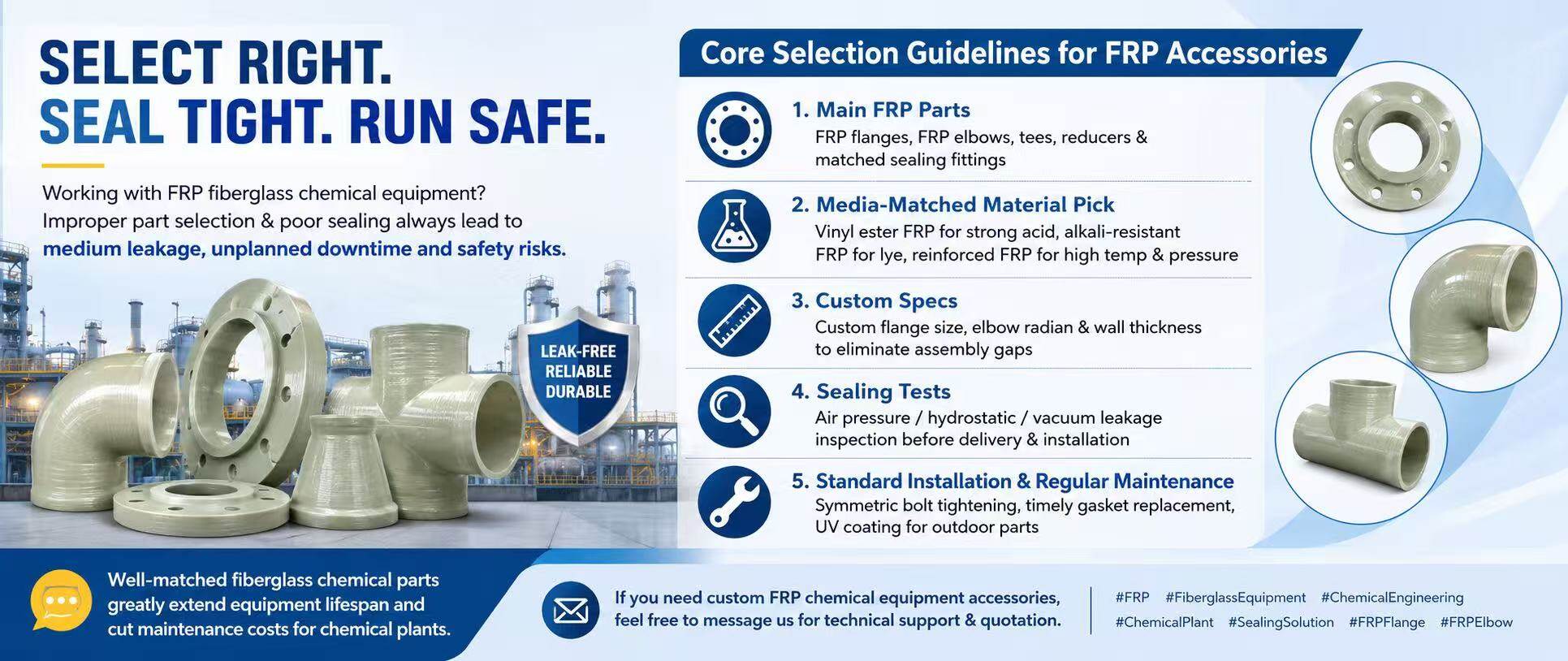
Key Points for Adaptability and Sealing Performance
Content Introduction
Fiberglass Reinforced Plastic (FRP) chemical equipment parts have become core components of modern chemical industrial systems due to their excellent corrosion resistance, lightweight properties, and high durability. In chemical production environments with complex media, high temperature, and high pressure, the rational selection of FRP equipment parts directly determines the operational safety, sealing stability, and service life of the entire production line. This article comprehensively elaborates on the classification of fiberglass chemical equipment accessories, media-matched material selection standards, customized specification design principles, professional sealing performance detection methods, and standardized installation and daily maintenance skills, focusing on solving common problems such as poor adaptability, sealing leakage, and short service life of FRP parts in chemical industrial applications, providing a systematic and practical selection guide for chemical engineering practitioners.
2. Full-Length SEO Optimized Blog Content
In the chemical industry, equipment safety and operational stability are the core foundations of sustainable production. Traditional metal equipment accessories are prone to corrosion, rust, and aging when exposed to acid, alkali, salt, and organic chemical media for a long time, resulting in frequent leakage, equipment failure, and increased maintenance costs. As a high-performance composite material, Fiberglass Reinforced Plastic (FRP) has gradually replaced traditional metal, plastic, and rubber accessories and become the preferred material for chemical equipment parts by virtue of its superior anti-corrosion performance, high mechanical strength, low thermal conductivity, and customizable structural performance. The selection of fiberglass chemical equipment parts focusing on adaptability and sealing performance is the key to avoiding chemical medium leakage, reducing equipment failure rates, and extending equipment service life.
However, many chemical enterprises often face various problems in the actual selection and application of FRP accessories: mismatched part types and working conditions, unreasonable material selection leading to medium corrosion damage, non-standard customized specifications affecting assembly accuracy, unqualified sealing performance causing hidden leakage dangers, and irregular installation and maintenance accelerating part aging. To solve these pain points, this guide systematically sorts out the full-process key points of fiberglass chemical equipment parts selection, covering part classification, material adaptation, specification customization, sealing detection, installation standards, and maintenance strategies, to help enterprises realize scientific selection and standardized application of FRP accessories.
2.1 Scientific Classification of Fiberglass Chemical Equipment Accessories
Fiberglass chemical equipment accessories are diverse in types, and different parts undertake different structural connection, fluid transmission, and sealing protection functions in chemical production systems. Scientific classification and targeted selection according to equipment working conditions is the primary premise of ensuring part adaptability. The most widely used core accessories in chemical industrial scenarios are divided into FRP flanges, FRP elbows, FRP tees, FRP reducers, FRP pipe caps, and sealing auxiliary parts, each with unique application scenarios and selection standards.
FRP flanges are the most critical connecting accessories in chemical pipeline and equipment systems, mainly used for the detachable connection between pipes, equipment tanks, valves, and other components. According to the structural form, they can be divided into flat welding FRP flanges, integral FRP flanges, socket welding FRP flanges, and blind FRP flanges. Flat welding flanges are suitable for low-pressure and normal-temperature conventional chemical medium transmission pipelines; integral flanges have high structural rigidity and are applicable to high-pressure, high-temperature industrial equipment connections; blind flanges are mainly used for pipeline port sealing and equipment temporary closure, undertaking pressure bearing and sealing isolation functions.
FRP elbows are core accessories for changing the direction of chemical fluid transmission pipelines, including 90-degree elbows, 45-degree elbows, and 180-degree return elbows. In chemical production, fluid often contains corrosive particles, viscous media, or high-flow-rate chemical solutions. FRP elbows can avoid the erosion and corrosion problems that metal elbows are prone to at pipeline turning points. Different bending radii and wall thicknesses of elbows are suitable for different flow rates and medium characteristics: large-radius elbows are used for high-flow and low-resistance fluid transmission, while thick-walled reinforced elbows are suitable for particle-containing corrosive media to prevent local wear and leakage.
In addition to flanges and elbows, FRP tees for fluid shunting and confluence, FRP reducers for pipeline caliber conversion, and supporting sealing gaskets and fasteners are indispensable supporting accessories for chemical equipment systems. All accessories need to be selected in a matching manner according to the overall pipeline parameters, equipment pressure level, and medium characteristics to ensure the overall structural adaptability of the system.
2.2 Core Principle of Material Selection: Perfect Adaptation to Chemical Media
The excellent performance of fiberglass chemical equipment parts is based on media-adaptive material formula design. Different chemical media have different corrosive, oxidative, and erosive properties, and ordinary FRP materials cannot meet the service requirements of all working conditions. Unscientific material matching is the main cause of early aging, cracking, and sealing failure of FRP accessories. Therefore, material selection must take the chemical characteristics, temperature, pressure, and concentration of the medium as the core basis.
For acidic chemical media such as dilute sulfuric acid, hydrochloric acid, and acetic acid, alkali-resistant and acid-resistant modified FRP materials should be selected. This type of material adopts acid-resistant resin matrix and high-strength glass fiber reinforcement, which can effectively resist the chemical corrosion of acidic media and avoid matrix peeling and fiber delamination. For high-concentration strong acid and strong oxidizing media such as concentrated nitric acid and concentrated sulfuric acid, high-performance vinyl ester resin FRP accessories are required, which have ultra-strong oxidation resistance and chemical stability and can maintain stable structural performance for a long time in harsh strong acid environments.
For alkaline media such as sodium hydroxide and potassium hydroxide solution, alkaline-resistant modified FRP materials are the best choice. Ordinary epoxy resin FRP is prone to alkali hydrolysis and structural damage in long-term alkaline environments, while specially modified alkali-resistant FRP can effectively resist alkali erosion and prevent part swelling and cracking. For salt-containing media such as seawater, brine, and industrial salt solution, standard corrosion-resistant FRP materials can meet the demand, with excellent anti-salt spray and anti-electrochemical corrosion performance, avoiding the rust and corrosion problems of metal parts.
In addition to medium characteristics, temperature and pressure are also key factors for material selection. For high-temperature chemical working conditions above 80℃, high-temperature resistant modified FRP accessories must be selected to prevent resin softening, strength reduction, and sealing failure caused by high temperature; for high-pressure pipeline systems, high-strength reinforced FRP materials with increased fiber content and structural thickness are required to ensure mechanical stability and pressure resistance of parts.
2.3 Custom Specification Design: Improve Assembly Adaptability and System Matching
Standardized FRP accessories can meet the needs of conventional chemical production systems, but most complex chemical equipment and non-standard pipeline systems require customized specification design to achieve precise matching and optimal sealing effect. The specification customization of fiberglass chemical equipment parts needs to comprehensively consider pipeline caliber, equipment interface size, working pressure, installation space, and fluid flow parameters.
In terms of size customization, the flange diameter, bolt hole spacing, sealing surface width, elbow bending radius, pipe wall thickness, and interface caliber must be designed in strict accordance with national chemical industry standards and enterprise equipment parameters. Too large or too small specification deviation will lead to poor assembly fit, resulting in gaps at the connection parts, which directly affects the sealing performance of the equipment system. For special-shaped equipment interfaces and limited installation space, non-standard customized FRP parts with optimized structure can effectively solve the problem of difficult installation and poor matching of standard parts.
In terms of structural customization, for high-flow, easy-to-wear chemical media, the inner wall of FRP parts can be reinforced and thickened, and anti-wear coating treatment can be carried out to improve wear resistance; for vacuum chemical equipment systems, high-tightness structural customization is adopted to enhance the fitting precision of sealing surfaces and avoid air leakage; for outdoor open-air equipment, anti-ultraviolet and aging-resistant structural customization is carried out to adapt to harsh outdoor environmental conditions and extend the service life of parts.
The core goal of specification customization is to realize zero-error assembly and full-system adaptation, eliminate sealing hidden dangers caused by specification mismatch, and ensure that FRP parts can coordinate and operate stably with chemical equipment and pipeline systems.
2.4 Sealing Performance Detection: Strictly Control the Core Index of Equipment Safety
Sealing performance is the most core evaluation index of fiberglass chemical equipment parts quality. Chemical media are mostly corrosive, toxic, and harmful flammable and explosive substances. Once leakage occurs, it will cause equipment failure, environmental pollution, and even major safety accidents. Therefore, professional and standardized sealing detection must be carried out before and after the installation of FRP accessories to ensure zero leakage of the system.
Common sealing detection methods for fiberglass chemical equipment parts include air pressure tightness test, water pressure tightness test, and vacuum leakage test. The air pressure test is suitable for most pipeline and equipment connection parts: inject dry compressed air into the closed system, maintain the specified working pressure for 30-60 minutes, and observe the pressure change. If the pressure drop is within the national standard allowable range and no bubble leakage occurs at the sealing connection, the sealing performance is qualified.
The water pressure test is applicable to high-pressure chemical equipment systems. Fill the equipment and pipeline system with clean water, pressurize to 1.25 times the rated working pressure, hold the pressure for a long time, and check all flange connections, elbow interfaces, and customized parts for water seepage, leakage, and sweating. This method can accurately detect the micro-leakage hidden dangers of FRP parts under high-pressure working conditions.
For vacuum chemical equipment and low-pressure micro-leakage sensitive systems, a vacuum leakage test is required. Vacuumize the system to the specified vacuum degree, keep the pressure stable, and monitor the vacuum degree change in real time. Stable vacuum degree indicates excellent sealing performance. In addition to the overall system detection, the sealing surface of a single FRP part should be inspected one by one before installation to check for scratches, cracks, deformation, and other defects that affect the sealing effect, so as to eliminate unqualified parts from the source.
2.5 Standardized Installation Skills: Lay a Foundation for Stable Sealing Operation
High-quality FRP accessories and qualified sealing performance cannot guarantee long-term stable operation without standardized installation technology. Irregular installation is one of the important causes of late sealing leakage and part damage. The installation of fiberglass chemical equipment parts needs to follow professional industry specifications and master key operational skills.
First, clean the installation interface thoroughly before construction. Remove dust, oil, rust, and residual sundries on the sealing surface of FRP flanges, elbows, and equipment interfaces to ensure that the sealing surface is flat and clean, avoiding gap leakage caused by sundry padding. Second, select supporting sealing gaskets according to working conditions. Match corrosion-resistant rubber gaskets, PTFE gaskets, or FRP special sealing gaskets according to the characteristics of chemical media to ensure that the gasket material is compatible with the medium and will not be corroded and failed.
In the bolt fastening process of flange connection, the symmetrical cross fastening method must be adopted to ensure uniform stress on the flange sealing surface. Avoid one-side excessive fastening leading to flange deformation, uneven gap, and local leakage. For high-pressure and high-temperature equipment connections, after the first fastening, secondary tightening treatment is required after equipment preheating to compensate for the stress change caused by thermal expansion and cold contraction.
For the installation of FRP elbows, tees, and other pipeline steering and shunting parts, ensure that the pipeline axis is aligned, avoid forced assembly and distortion stress, prevent long-term stress concentration from causing part cracking and sealing failure. After installation, conduct a secondary sealing test to confirm that all connection parts are tightly fitted and no leakage hidden dangers exist.
2.6 Scientific Daily Maintenance: Extend Service Life and Maintain Long-Term Sealing Stability
Fiberglass chemical equipment parts have good durability, but long-term operation in complex chemical working conditions will still produce aging, wear, and sealing performance attenuation. Scientific daily maintenance and regular inspection can effectively extend the service life of FRP accessories, maintain long-term sealing stability, and reduce enterprise replacement and maintenance costs.
Establish a regular inspection mechanism: conduct daily visual inspection of FRP parts appearance, check for surface cracking, peeling, deformation, and medium corrosion traces; regularly detect the tightness of connection parts, focus on monitoring flange, elbow, and special-shaped customized parts that are prone to leakage, and discover micro-leakage hidden dangers in time. For equipment operating in high-temperature, high-pressure, and strong corrosion environments, increase the inspection frequency to once a week.
Do a good job in environmental protection maintenance: avoid long-term exposure of outdoor FRP parts to strong ultraviolet radiation, and regularly coat anti-ultraviolet protective coating to prevent material aging and brittleness; keep the equipment installation environment dry and clean, avoid long-term accumulation of corrosive liquid and dust on the surface of parts.
Timely replace vulnerable parts: sealing gaskets and fasteners are vulnerable auxiliary parts, which will age and deform after long-term use. Regular replacement is required according to the service cycle to avoid sealing failure caused by gasket aging. For FRP parts with slight wear and surface damage, professional repair and reinforcement can be carried out in time to avoid further expansion of damage affecting overall sealing and structural stability.
3. Conclusion
The selection and application of fiberglass chemical equipment parts is a systematic project focusing on adaptability and sealing performance. Scientific classification selection, media-matched material configuration, precise specification customization, strict sealing detection, standardized installation operation, and refined daily maintenance are indispensable key links to ensure the safe and stable operation of chemical equipment systems. In the increasingly stringent chemical production safety standards, enterprises should abandon the traditional single selection concept, take working condition adaptation and sealing stability as the core, and realize the whole-process standardized management of FRP parts selection, installation and maintenance, so as to effectively reduce equipment leakage failures, improve production safety, and create greater economic and safety benefits for chemical production.
Core SEO Keywords (Embedded in Full Text)
Primary keywords: fiberglass chemical equipment parts, FRP parts selection, chemical equipment sealing performance, FRP adaptability selection
Secondary keywords: FRP flange selection, FRP elbow application, chemical medium adaptive material, fiberglass parts sealing detection, FRP equipment installation and maintenance, customized FRP chemical parts