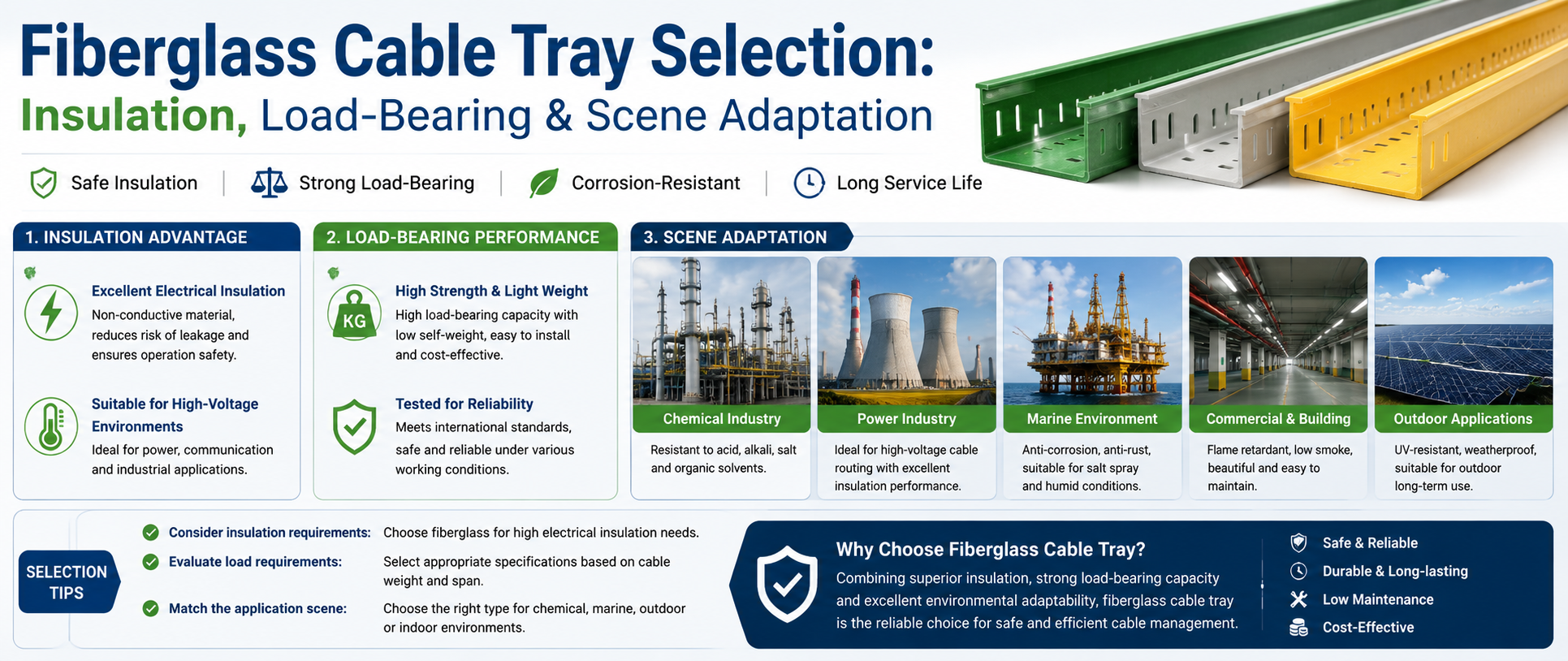
Fiberglass cable trays feature outstanding corrosion resistance and insulation, widely applied in power and construction sectors. This guide details core selection criteria: mainstream trough and tray styles, insulation standards, load-bearing specs, scenario-specific recommendations and standard installation rules. It aids engineers in proper product selection to guarantee safe, stable cable routing with extended service life across various projects.
1. How to Select Qualified Fiberglass Guardrails: Height & Thickness Guide
Scientific fiberglass guardrail selection is the foundation of safe and long-term service. Most on-site quality problems are caused by mismatched height and wall thickness for specific application scenarios. To help users select the most suitable fiberglass safety guardrail, we sort out industry-standard selection specifications for different usage environments.
1.1 Standard Guardrail Height Selection by Scenario
Guardrail height directly determines the safety protection capacity. For residential communities, villa courtyards, and pedestrian walkways, a height of 1.0m to 1.2m is the mainstream choice, balancing safety and visual aesthetics. For general industrial workshops, equipment isolation areas, and factory passageways, 1.2m to 1.5m high FRP guardrails are required to prevent collision and falling accidents. For high-risk scenarios such as chemical tank areas, high-altitude operation platforms, and sewage pool peripheries, the protective height should reach 1.5m to 1.8m to meet industrial safety specifications. In public scenic spots and children’s activity areas, the minimum height is strictly controlled above 1.1m to eliminate potential safety risks.
1.2 Reasonable Wall Thickness Selection
Wall thickness is the core indicator of guardrail impact resistance and structural stability. The wall thickness of conventional fiberglass anti-corrosion guardrails ranges from 2.0mm to 5.0mm. Thin-walled products of 2.0mm–2.5mm are suitable for light-duty scenarios such as indoor zoning, landscape decoration, and residential isolation, with economic cost and lightweight advantages. The 3.0mm–4.0mm medium-thickness guardrails are the most versatile type, widely used in outdoor parks, community roads, and ordinary industrial isolation projects, with excellent toughness and compression resistance. For heavy-duty industrial environments with strong impact, high wind, and severe corrosion, 4.0mm–5.0mm thickened fiberglass guardrails are highly recommended to ensure long-term structural stability.
2. Must-Have Tools for Professional Fiberglass Guardrail Installation
Standard fiberglass guardrail installation relies on complete professional tools to ensure accurate positioning, neat cutting, and firm fixation. Incomplete tools will easily cause installation deviation, interface gaps, and loose assembly. Before construction, prepare all supporting tools in advance to improve construction efficiency and installation quality.
Precision measuring tools include tape measures, horizontal levels, and laser positioners, which are used to confirm installation spacing, verticality, and horizontality to ensure overall neatness. Special cutting tools such as fine-tooth saws and professional pipe cutters are adopted to avoid pipe wall cracking and burrs during cutting. Fixed installation tools cover electric drills, impact drills, expansion bolts, stainless steel fasteners, and special FRP connecting accessories. Auxiliary tools include sandpaper, professional sealant, cleaning cloths, and safety protective equipment for polishing cutting ports and sealing assembly gaps.
3. Standard Fiberglass Guardrail Installation Steps & Fixing Techniques
Standardized construction procedures and scientificfiberglass guardrail fixing methods are the key to avoiding post-installation loosening, deformation, and falling off. The complete installation process is divided into six standardized steps, suitable for all outdoor and industrial FRP guardrail projects.
Step 1: On-site Foundation Treatment
First, clean the installation base thoroughly, remove surface dust, gravel, oil stains, and floating layers. Inspect the flatness and bearing capacity of the concrete or steel foundation to ensure the ground is solid and flat, preventing uneven stress and guardrail tilt after installation.
Step 2: Precision Positioning and Marking
According to the design drawing and standard column spacing (1.2m–1.5m for conventional projects), use a laser locator and tape measure to mark accurate drilling positions. Uniform spacing ensures the overall aesthetic and structural balance of the FRP guardrail.
Step 3: Drilling and Base Fixing
Drill vertical holes at the marked positions and clean up internal dust. Two mature fixing methods are available: surface mounting and embedded mounting. Surface fixing is applicable to finished concrete ground and steel platforms, using high-strength expansion bolts to lock the column base firmly. Embedded fixing is suitable for new construction projects, embedding the column bottom 15–20cm into the concrete foundation and pouring concrete for solidification, achieving ultra-stable installation effect.
Step 4: Crossbar Assembly and Connection
After the vertical columns are completely fixed, assemble the upper and lower crossbars in sequence. Adopt special matching FRP connectors for seamless docking, lock all fixing screws one by one, and ensure no gaps or looseness at the connection interface.
Step 5: Overall Calibration and Polishing
Use a level to calibrate the verticality of columns and horizontality of crossbars to correct minor deviations. Polish all cutting ports with sandpaper to remove burrs and sharp edges, improving safety and appearance.
Step 6: Gap Sealing and Reinforcement
Fill assembly gaps with professional anti-corrosion sealant to enhance the overall tightness, prevent rainwater and salt fog from invading the interface, and further improve the fiberglass guardrail’s weather resistance and structural firmness.
4. Professional Fiberglass Guardrail Acceptance Standards
Post-construction acceptance is an essential link to guarantee project quality. Strictly implement unified fiberglass guardrail acceptance standards to eliminate potential safety and quality hazards.
In terms of structural firmness, all columns and crossbars must be tightly connected without shaking, loosening, or falling accessories, and the overall structure can resist conventional external impact. In terms of installation accuracy, the vertical deviation of a single column shall not exceed 3mm, and the horizontal deviation of crossbars shall be controlled within 2mm with uniform column spacing. In terms of surface quality, the guardrail surface must be smooth and flat without cracks, peeling, fading, or obvious color difference, with neat and smooth joints. In terms of safety performance, no sharp edges and corners are allowed, and the height and thickness fully comply with scenario safety specifications. The overall layout must be neat and uniform with smooth lines, meeting design and aesthetic requirements.
5. Practical Daily Maintenance Tips to Extend Service Life
Although fiberglass guardrails have excellent durability and low-consumption performance, scientific daily maintenance can effectively extend their service life and maintain long-term perfect appearance, reducing later replacement and maintenance costs.
Carry out regular surface cleaning, wipe dust and conventional stains with a damp cloth, and clean stubborn oil stains with neutral detergent, avoiding strong acid and alkali corrosives to protect the surface anti-aging layer. Conduct quarterly inspection of connecting screws and connectors, tighten loose parts in time, and replace aging and damaged accessories immediately. Avoid long-term heavy hard object impact and surface scratching to prevent coating damage and pipe wall cracking. For coastal and high-humidity areas, regularly clean surface salt fog and water stains to avoid residual corrosion; for low-temperature areas, check sealant integrity in winter to prevent cracking and water penetration.
6. Scientific Fiberglass Guardrail Color Customization Suggestions
Reasonable fiberglass guardrail color customization can realize dual effects of safety warning and environmental integration. We provide targeted color matching suggestions for different application scenarios.
For industrial anti-corrosion and high-risk areas, yellow, yellow-black warning color, and red are preferred, with strong visual warning effects to remind personnel of safety precautions. For residential communities, urban parks, and scenic landscapes, white, sky blue, and dark green are ideal, which are fresh and versatile, perfectly integrating with the surrounding environment and improving overall aesthetics. For municipal engineering and public passageways, gray and dark blue are commonly used, featuring wear resistance and dirt resistance. It is recommended to adopt integral color injection during production, which has higher color fastness and better weather resistance than post-spraying, avoiding long-term outdoor fading and peeling.
Conclusion
High-quality fiberglass guardrail installation starts with scientific model selection, relies on standardized construction processes, and is guaranteed by strict acceptance and refined maintenance. As a high-performance alternative to traditional guardrails, FRP guardrails have irreplaceable advantages in anti-corrosion, durability, and cost performance. This full-process guide helps engineering contractors, procurement teams, and project owners complete professional installation and configuration, ensuring that every fiberglass guardrail project achieves stable structure, beautiful appearance, long service life, and low later maintenance cost.
Core SEO Keywords: fiberglass guardrail installation, FRP guardrail selection, fiberglass guardrail maintenance, fiberglass guardrail acceptance standards, fiberglass guardrail color customization, fiberglass anti-corrosion guardrail, FRP safety guardrail