Eco-Friendly Solutions for Residential and Rural Scenarios
In modern residential construction and rural environmental renovation, fiberglass septic tanks have gradually become the preferred eco-friendly sewage treatment facility, replacing traditional brick and concrete septic tanks. Thanks to their outstanding corrosion resistance, lightweight structure, excellent sealing performance, and long service life, fiberglass septic tanks perfectly meet the decentralized sewage treatment needs of urban residential communities, single-family homes, rural self-built houses, and suburban settlements. Choosing a suitable fiberglass septic tank and implementing standardized installation and daily maintenance is crucial to ensuring efficient sewage purification, avoiding environmental pollution, and complying with local environmental protection regulations. This comprehensive guide will elaborate on the core knowledge of fiberglass septic tank capacity selection, professional installation procedures, advanced sealing technology, environmental compliance standards, and scientific daily cleaning and maintenance methods, providing practical and reliable eco-friendly sewage disposal solutions for both residential and rural scenarios.
1. Scientific Selection of Fiberglass Septic Tank Capacity: Based on Population and Water Consumption
The primary premise of purchasing a qualified fiberglass septic tank is to select a reasonable tank capacity, which directly determines the sewage treatment efficiency, sludge settling effect, and service cycle of the equipment. Improper capacity selection—either overly large leading to wasted construction costs or overly small causing sewage overflow and incomplete purification—will seriously affect the living environment and environmental safety. The capacity selection of residential and rural fiberglass septic tanks mainly relies on two core indicators: the number of permanent users (population) and daily domestic water consumption, combined with the actual usage scenarios for comprehensive judgment.
For single-family residential scenarios in urban and suburban areas, the daily domestic water consumption per capita is usually calculated at 150-200 liters, including daily washing, cooking, bathing, and toilet flushing sewage. For a family of 3-5 people, a 2-4 cubic meter fiberglass septic tank is the most mainstream and practical choice, which can fully meet daily sewage storage, anaerobic fermentation, and preliminary purification needs. For multi-story residential buildings and community concentrated residential areas with a larger population base, it is necessary to calculate the total daily sewage discharge according to the total number of residents, and select integrated large-capacity fiberglass septic tanks of 10 cubic meters, 20 cubic meters or even larger specifications to ensure continuous and stable sewage treatment capacity.
For rural scenarios, the capacity selection standards need to be appropriately adjusted according to rural living characteristics. Rural households usually have scattered living spaces, relatively single domestic sewage components, and lower per capita water consumption (about 100-150 liters per person per day) than urban residents. However, rural families often have large family populations and may produce seasonal peak sewage discharge during festivals and farming seasons. Therefore, rural fiberglass septic tank selection advocates a moderately enlarged capacity principle. A 3-6 cubic meter fiberglass septic tank is recommended for ordinary rural families to avoid sewage backflow and sludge accumulation caused by peak water use. In addition, for rural centralized resettlement areas and village-level unified sewage treatment projects, customized large-capacity fiberglass septic tank combinations are required to adapt to the overall sewage treatment layout of the village.
It is worth noting that in capacity selection, we should also reserve a certain margin according to the local climate and soil environment. In rainy areas, the soil has high humidity and poor drainage, and the septic tank is prone to external water pressure extrusion, so a slightly larger capacity and high-pressure resistant fiberglass septic tank should be selected; in cold northern areas, the anaerobic fermentation cycle of sewage is longer in low-temperature environments, and a moderate capacity margin can ensure sufficient sewage purification time and improve treatment quality.
2. Standard Installation Process of Fiberglass Septic Tanks for Residential and Rural Use
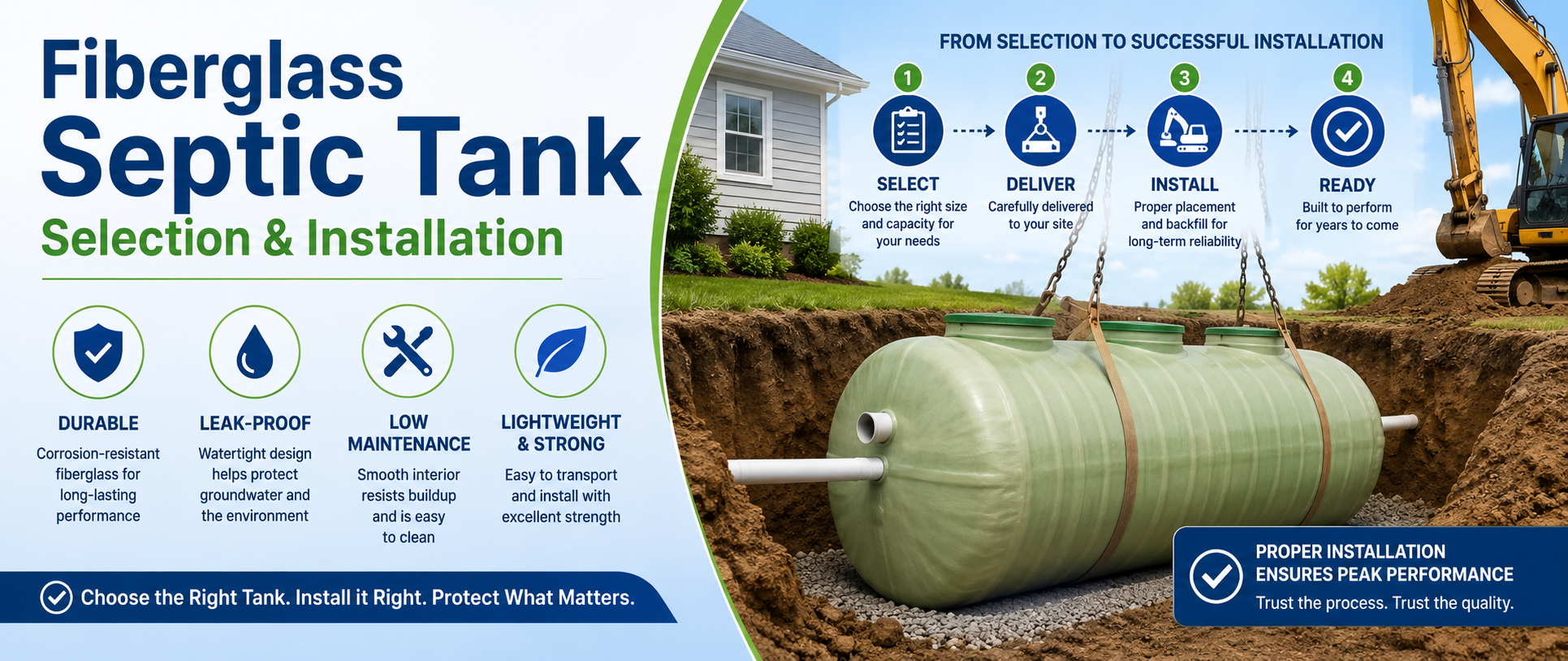
High-quality fiberglass septic tank products need to be matched with standardized installation processes to give full play to their eco-friendly sewage treatment advantages. Non-standard installation is one of the main causes of septic tank leakage, pipeline blockage, and treatment failure. The installation of residential and rural fiberglass septic tanks follows a set of mature and standardized construction procedures, which are applicable to most family self-built houses, residential communities, and rural sewage renovation projects.
The first step is site selection and foundation excavation. The installation site should be chosen in a flat, well-drained area far from residential buildings, drinking water sources, vegetable fields, and public passages, avoiding low-lying waterlogged areas and heavy vehicle rolling areas to prevent tank body deformation and damage. According to the size and buried depth of the selected fiberglass septic tank, excavate the tank pit and pipeline trench. The pit bottom needs to be leveled and compacted, and a 10-20cm thick sand and gravel cushion is paved to ensure uniform stress on the tank body and prevent uneven settlement caused by loose soil.
The second step is tank hoisting and positioning. After the foundation is processed, use professional hoisting equipment to place the fiberglass septic tank steadily into the pit. During the placement process, ensure the tank body is horizontal without tilt, and accurately adjust the interface position of the water inlet and outlet pipelines to match the pre-buried sewage pipeline of the house. After positioning, fix the tank body temporarily to avoid displacement during backfilling.
The third step is pipeline connection and sealing treatment. Connect the domestic sewage inlet pipe and the purified water outlet pipe in strict accordance with the design standards. All pipeline interfaces need to be matched with professional sealing accessories, and the connection gaps are filled and sealed to prevent sewage leakage and external groundwater infiltration. This link is closely combined with the core sealing technology of fiberglass septic tanks, which is the key to ensuring the tightness of the whole equipment.
The fourth step is layered backfilling and compaction. After the pipeline connection is completed and the tightness test is passed, carry out layered backfilling of soil around the tank body. The backfilling soil should be fine soil without hard stones and sharp impurities, and each layer of 20-30cm soil needs to be compacted manually or mechanically to ensure the tank body is firmly fixed and resist external soil pressure. Finally, complete the surface soil covering and restore the original terrain of the construction site.
The last step is commissioning and acceptance. After the installation is completed, inject clean water into the septic tank for water sealing test and pressure test to check for pipeline blockage, interface leakage, and tank body damage. After confirming that all indicators are qualified, the equipment can be put into formal use to ensure that the sewage can enter the tank smoothly for anaerobic decomposition and purification treatment.
3. Advanced Sealing Technology: Core Guarantee for Leak-Proof and Eco-Friendly Operation
Sealing performance is the core technical indicator that distinguishes high-quality fiberglass septic tanks from inferior products, and it is also the key to preventing secondary environmental pollution in residential and rural sewage treatment. Traditional concrete septic tanks are prone to cracking, gap leakage, and groundwater backflow due to poor overall sealing, resulting in untreated domestic sewage penetrating into the soil and polluting underground water sources and farmland. Modern high-performance fiberglass septic tanks adopt integrated molding and multi-layer sealing technology, which completely solves the leakage pain point of traditional septic tank equipment.
First of all, the integrated one-piece molding process is the foundation of excellent sealing performance. High-quality fiberglass septic tanks are integrally formed by high-temperature resin and glass fiber winding, with no welding gaps, assembly interfaces, or structural cracks on the whole tank body. Compared with assembled septic tanks, the integrated fiberglass structure has higher overall rigidity and better air tightness and water tightness, which can effectively isolate the internal sewage and external soil and water environment, and avoid sewage leakage pollution in residential and rural scenarios.
Secondly, professional interface sealing technology further enhances the overall tightness of the equipment. The water inlet and outlet interfaces of the fiberglass septic tank adopt customized rubber sealing rings and anti-aging resin glue sealing technology. The sealing accessories have excellent corrosion resistance, high and low temperature resistance, and aging resistance, which can maintain stable sealing performance for a long time in complex underground soil environments. It can not only prevent the internal treated and untreated sewage from overflowing along the pipeline gap but also block the infiltration of external rainwater and groundwater, ensuring the stable concentration of sewage in the tank and avoiding the reduction of purification efficiency caused by water dilution.
In addition, the anti-corrosion and anti-leakage coating technology of the tank body optimizes the long-term sealing effect. The inner and outer walls of the fiberglass septic tank are coated with special anti-corrosion resin coatings, which can resist the erosion of acidic and alkaline substances in domestic sewage and soil, prevent the tank body from being corroded and perforated, and ensure that the equipment maintains zero leakage performance during the 30-50 year service life. This advanced sealing technology makes fiberglass septic tanks the most reliable eco-friendly sewage treatment equipment for rural household sewage and residential domestic sewage treatment.
4. Environmental Compliance Requirements for Residential and Rural Fiberglass Septic Tank Projects
In the context of increasingly strict rural environmental governance and residential green construction standards, the installation and use of fiberglass septic tanks must comply with national and local environmental protection and construction specifications to ensure that sewage treatment meets discharge standards and avoid environmental penalties and hidden dangers. Whether it is family decentralized installation or village centralized sewage renovation projects, relevant environmental compliance requirements must be strictly implemented in the selection, installation, and operation links.
In terms of product qualification compliance, the selected fiberglass septic tank products must meet national industry standards for fiberglass sewage treatment equipment, with formal product qualification certificates, environmental protection test reports, and quality inspection reports. The equipment must have qualified anaerobic purification function, which can effectively decompose organic matter in domestic sewage, reduce chemical oxygen demand (COD) and biochemical oxygen demand (BOD) of sewage, and ensure that the discharged water after treatment meets the local domestic sewage discharge standards. Inferior unqualified fiberglass septic tanks with incomplete purification functions are prohibited from being used in residential and rural environmental protection projects.
In terms of construction and installation compliance, the installation position, buried depth, pipeline layout, and anti-seepage measures of the septic tank must comply with the technical specifications for rural domestic sewage treatment and residential community environmental construction. It is forbidden to install septic tanks near drinking water wells, river channels, farmland irrigation water sources, and residential living areas to prevent potential pollution of water sources and living environments. The construction process must be carried out by professional construction teams in accordance with standardized procedures, and the construction quality acceptance must be completed after the completion of construction to ensure that the anti-leakage and anti-seepage indicators meet the compliance standards.
In terms of operation and environmental protection compliance, the daily operation and discharge of fiberglass septic tanks must not cause secondary pollution. The sludge and floating dirt produced by sewage fermentation must be regularly cleaned and transported for harmless treatment, and it is forbidden to dump sludge randomly in rural farmland, river channels, and residential green spaces. For large-scale residential communities and rural centralized sewage treatment projects, it is also necessary to establish operation records of septic tank equipment, regularly monitor the water quality of discharged water, and ensure long-term compliance and stable operation of the equipment.
5. Daily Cleaning and Scientific Maintenance Methods for Fiberglass Septic Tanks
Standardized daily cleaning and maintenance are important measures to extend the service life of fiberglass septic tanks, maintain efficient sewage treatment capacity, and avoid equipment failure and environmental pollution. Fiberglass septic tanks have the advantages of wear resistance, corrosion resistance, and not easy to deform, but long-term operation will produce sludge deposition, floating residue accumulation, and pipeline scaling problems. Scientific maintenance can effectively avoid common faults such as sewage backflow, pipeline blockage, and reduced purification efficiency, suitable for all residential and rural use scenarios.
First, regular sludge cleaning and residue removal is the core maintenance work. Domestic sewage undergoes anaerobic fermentation in the fiberglass septic tank, and the suspended organic matter will gradually settle to form sludge, and grease and floating debris will accumulate on the liquid surface. For ordinary household small-capacity fiberglass septic tanks, it is recommended to carry out thorough sludge suction and residue cleaning every 1-2 years; for large-capacity equipment used in residential communities and rural centralized treatment points, the cleaning cycle can be adjusted to 2-3 years according to the actual sewage discharge. It is necessary to find professional sewage suction and cleaning teams for construction, and thoroughly clean the sludge at the bottom of the tank and the floating dirt on the upper layer to ensure the internal space of the tank is unobstructed and the fermentation and purification functions are normal.
Second, daily pipeline inspection and dredging cannot be ignored. Regularly check the water inlet and outlet pipelines of the septic tank to observe whether there is slow water flow, pipeline blockage, water accumulation and backflow in the pipeline. For the grease scale and debris accumulated in the pipeline, regular dredging treatment is required to ensure smooth sewage circulation. At the same time, check the sealing degree of the pipeline interface regularly. If aging, cracking or loose sealing of the sealing ring is found, replace the accessories in time to avoid leakage.
Third, daily use standardized management reduces equipment operation load. In the daily use process of residential and rural families, it is forbidden to pour a large amount of grease, toilet paper, plastic debris, chemical detergents, and corrosive substances into the septic tank. Excessive grease will cause pipeline scaling and block anaerobic bacteria activity, chemical corrosives will destroy the internal fermentation environment of the tank, and large particle debris will accumulate and occupy the tank capacity, which will affect the sewage treatment effect and accelerate equipment aging.
Finally, seasonal targeted maintenance adapts to different environmental conditions. In rainy seasons, it is necessary to check the drainage around the septic tank pit in time to avoid water soaking and soil loosening causing tank displacement; in winter low-temperature environments, properly increase the inspection frequency to prevent the pipeline from freezing and blocking, and ensure the normal operation of anaerobic fermentation in the tank. After long-term use, regularly check the tank body for deformation, corrosion and damage to ensure the long-term stable operation of the fiberglass septic tank.
6. Conclusion: Fiberglass Septic Tanks – Ideal Eco-Friendly Solution for Residential and Rural Sewage Treatment
As a high-efficiency, durable, safe and eco-friendly sewage treatment facility, fiberglass septic tanks perfectly adapt to the decentralized sewage treatment characteristics of urban residential buildings, suburban families, and rural residential areas. Scientific capacity selection based on population and water consumption, standardized professional installation technology, high-standard integrated sealing technology, strict environmental compliance operation, and standardized daily maintenance management together constitute the complete application system of fiberglass septic tanks in residential and rural scenarios. Compared with traditional septic tank products, fiberglass septic tanks have obvious advantages in anti-leakage, anti-corrosion, environmental protection, and cost performance, which can effectively solve the problem of domestic sewage pollution in residential and rural areas, protect soil and groundwater resources, and help promote rural ecological environmental governance and green residential construction. Mastering the above selection, installation, compliance and maintenance knowledge can help every user rationally configure equipment, reduce operation costs, and realize long-term stable and eco-friendly sewage treatment.