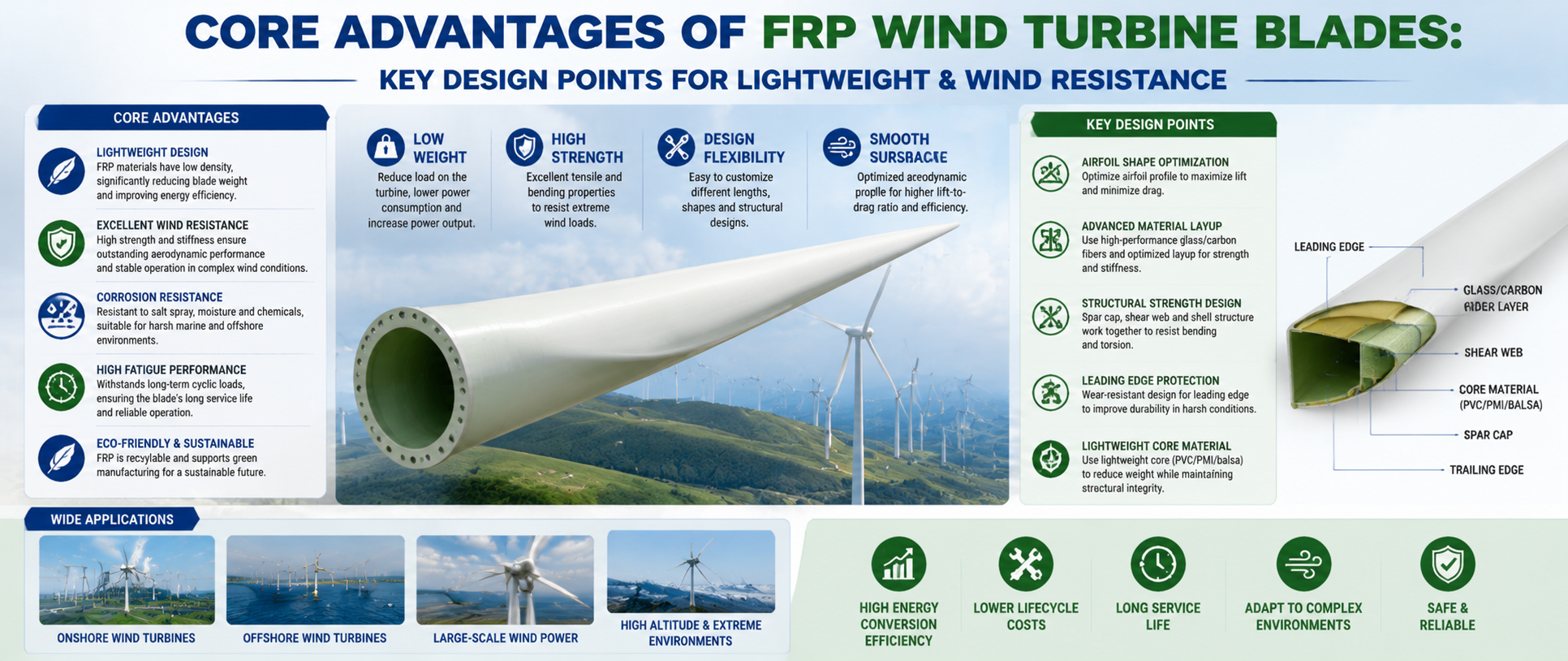
FRP (Fiberglass Reinforced Plastic) wind turbine blades have become the mainstream core component of modern wind power generation systems due to their unique composite material properties. This article deeply analyzes the core strengths of lightweight performance and superior wind resistance of Huangang FRP wind turbine blades, elaborates on professional design points including material composition, lightweight optimization logic, wind-proof and anti-aging treatment technology
1. Premium Material Composition of FRP Wind Turbine Blades
The excellent performance of FRP wind turbine blades stems from scientific and standardized fiberglass composite material formulation and structural layup design. Huangang high-strength fiberglass wind blades adopt high-quality E-glass fiber as the reinforcing skeleton, matched with weather-resistant thermosetting resin matrix, and integrate professional sandwich structure and multi-layer fiber laying technology. Different from ordinary plastic and metal blades, this fiberglass reinforced plastic composite material features high tensile strength, strong structural toughness and excellent overall stability.
We optimize the fiber distribution structure in a targeted manner: high-density fiberglass layup is adopted at the blade root and load-bearing key areas to enhance bending and torsion resistance, while the blade middle and tip areas adopt lightweight sparse layup design. This professional material layout eliminates redundant materials while ensuring structural safety, realizing the perfect balance between high structural strength and ultra-light weight, which lays a solid foundation for the efficient operation of wind power equipment.
2. How Lightweight Design Improves Wind Power Generation Efficiency
Lightweight design is the core competitive advantage of modern fiberglass wind turbine blades and a key factor in improving overall wind power generation efficiency. Traditional metal blades are heavy and have large rotational inertia, which require high starting wind speed and cannot respond quickly to variable wind speeds. In contrast, Huangang FRP wind blades achieve significant weight reduction under the same structural strength standards.
The ultra-light fiberglass composite structure effectively reduces the self-weight load of the wind turbine unit, lowers the starting wind speed of the fan, enables the blade to capture low-speed wind resources efficiently, and greatly extends the effective power generation time. Meanwhile, the lightweight design reduces mechanical friction and operating load of the spindle, gearbox and other core components, reduces equipment energy consumption loss, and significantly improves the overall power generation conversion rate. In addition, the lightweight blade structure minimizes tower collision risks caused by excessive blade flexion in complex wind conditions, ensuring stable and continuous high-efficiency power generation of wind turbines.
3. Professional Wind Resistance & Anti-Aging Treatment Technology
Wind turbines operate in outdoor open-air environments for a long time, facing extreme challenges such as strong winds, storm impact, ultraviolet radiation, temperature difference aging and coastal salt fog erosion. Wind resistance and anti-aging performance determine the service life and operational stability of FRP wind turbine blades.
Huangang adopts mature integrated anti-aging and wind-resistant processing technology for all fiberglass wind blades. First, the overall streamline aerodynamic design optimizes the wind pressure bearing structure, disperses strong wind impact force, and effectively improves the blade's ultimate wind resistance and torsion resistance. Second, the blade surface is coated with high-performance weather-resistant anti-UV protective coating, which can resist long-term solar ultraviolet aging, prevent blade surface peeling, fading and brittleness. Third, the overall anti-corrosion and waterproof sealing treatment is added to adapt to harsh environments such as rainy, snowy, high humidity and coastal salt fog, avoiding internal fiber delamination and structural damage caused by moisture erosion. After professional wind-resistant reinforcement and anti-aging treatment, our FRP wind blades have a design service life of more than 20 years, adapting to all onshore and conventional offshore wind farm working conditions.
4. Customized Size Design Adapted to Diverse Wind Power Projects
Different wind farm terrain, wind speed conditions and power generation unit parameters have completely different requirements for blade specifications. Relying on professional FRP molding technology, Huangang supportsfull-size customized design of fiberglass wind turbine blades to meet personalized needs of small distributed wind power, medium commercial wind farms and large centralized wind power projects.
We can customize blade length, width, airfoil angle, structural thickness and overall specifications according to customer project parameters and wind field environment data. Combined with aerodynamic optimization and lightweight structural layout, the customized FRP blades can perfectly match local wind resource characteristics, maximize wind energy capture efficiency, and avoid energy waste caused by mismatched blade specifications. All customized wind blades strictly follow industrial wind power design standards, with unified lightweight, wind-resistant and anti-aging performance, ensuring stable and efficient operation of customized equipment.
5. Daily Detection & Professional Maintenance Skills for FRP Wind Blades
Scientific daily detection and standardized maintenance are key to maintaining the long-term high-efficiency operation of fiberglass wind turbine blades and extending service life. Combined with years of production and after-sales service experience, we summarize practical operation and maintenance guidelines for FRP wind blades:
Regular Visual Inspection: Regularly check the blade surface for cracks, peeling, coating damage, scratches and dirt accumulation, focusing on blade tips, leading edges and root connection parts which are prone to wind pressure wear.
Structural Performance Detection: Regularly detect blade torsion resistance, bending performance and internal fiber structure integrity to avoid hidden dangers such as internal delamination and structural fatigue caused by long-term wind load operation.
Surface Cleaning & Protection Maintenance: Regularly clean blade surface dust, bird droppings and attachments to avoid affecting aerodynamic performance and power generation efficiency; repair local coating damage in a timely manner and supplement anti-UV and anti-corrosion protective layers.
Environmental Adaptation Inspection: Strengthen inspection frequency in extreme weather such as strong winds, thunderstorms and typhoons, check blade firmness and structural deformation, and eliminate potential safety hazards in advance.
Regular Parameter Calibration: Cooperate with wind turbine unit operation data to calibrate blade rotation angle and wind capture parameters, ensure lightweight advantages are fully exerted, and maintain optimal power generation efficiency.
6. Conclusion: High-Performance FRP Blades Lead Wind Power Development
Lightweight design and superior wind resistance are the two core competitive advantages of FRP fiberglass wind turbine blades. Through optimized composite material proportioning, professional aerodynamic structural design, mature anti-aging and wind-resistant treatment, and flexible customized size service, Huangang high-performance wind blades effectively solve the pain points of heavy weight, low power generation efficiency and poor weather resistance of traditional wind power blades. Standardized daily detection and maintenance can further maximize equipment performance and extend service life. As a professional FRP wind blade manufacturer in Henan, China, we always focus on product performance optimization, providing reliable, efficient and durable fiberglass wind power components for global wind power engineering projects.